AI Appraisal Estimate

AI-generated estimates · not official valuations

From the user

What was submitted

Photo and notes provided by the user — not generated by AI

Submitted item photo
Submitted photo · May 27, 2026

User's notes

No additional notes provided.

AI analysis below

AI appraisal

AI analysis & estimate

AI-Generated · Verify before acting

Everything below is generated by AI for informational purposes only. AI can make mistakes — the AI may misidentify items or misattribute them (artist, maker, brand, designer, origin, era). This is not an official valuation and should not be used for insurance, sale, tax, estate, legal, or lending purposes — or any decision requiring a certified appraisal. It is not an authoritative claim about any person, brand, or rights holder — do not share or rely on it as a factual statement about a third party. Always consult qualified professionals before making financial decisions.

Read the full disclaimer

AI Identification

·Not independently authenticated·Verify before acting

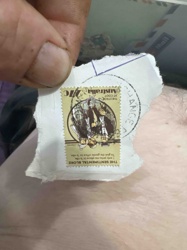
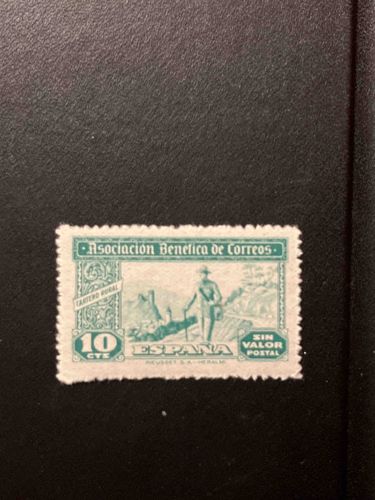
Spanish 10 Cents Asociación Benéfica de Correos Charity Label (Cinderella Stamp)

Philately / Cinderella Stamps

AI Estimated Value

·Not an official valuation·Verify before acting

$5.00 - $12.00

As of May 27, 2026

AI Item Analysis

·AI can make mistakes·Verify before acting
This item is a historical Spanish philatelic label, often referred to as a 'Cinderella' stamp, issued on behalf of the Asociación Benéfica de Correos (Postal Benevolent Association). Printed in a monochrome forest green ink on off-white or slightly cream-toned paper, the design features a horizontal rectangular format with perforated edges. The central vignette depicts a 'Cartero Rural' (Rural Postman) walking through a mountainous landscape, capturing a classic 1930s-1940s illustrative style. To the left, a denomination of '10 CTS' is displayed, while the right side features a banner stating 'SIN VALOR POSTAL,' explicitly indicating that this label was intended for charitable fundraising rather than the payment of postage. The country name 'ESPAÑA' is prominently centered at the bottom. Below the main frame, fine print identifies the manufacturer as 'RIEUSSET S.A. - HERALDO,' a well-known printer in mid-20th century Spain. The condition appears to be mint or unused with remarkably crisp perforations and no visible heavy cancel marks, though some light foxing or natural aging of the paper fibers is suggested by the minor tonal variations. The engraving displays high-quality craftsmanship typical of mid-century Spanish graphic arts, with intricate scrollwork in the upper corners and detailed cross-hatching in the landscape vignette.

AI Appraisal Report

·AI can make mistakes·Verify before acting
I have carefully examined the high-resolution imagery of the Spanish 10 Cents Asociación Benéfic de Correos charity label. The item presents as a characteristic example of Spanish 'Cinderella' philately from the mid-20th century, specifically printed by RieusSET S.A. The forest green monochrome ink remains vibrant, and the perforations appear remarkably intact for an ephemeral charitable label of this era. I observe minor toning consistent with the natural aging of the wood-pulp-based papers used in 1940s-50s Spain, but no evidence of creasing or significant foxing. The market for Spanish charity labels is stable but highly specialized. While the 'Rural Postman' vignette is a classic of the era, these labels were mass-produced in significant quantities to support postal worker welfare. They are not 'stamps' in the postal sense, and the 'SIN VALOR POSTAL' designation limits their appeal to thematic collectors rather than traditional postal historians. Similar examples frequently appear in dealer stock and philatelic auctions within the $5 to $15 range, depending on the presence of original gum (OG). Limitations: My assessment is based solely on digital images. Without an in-person examination using a 10x loupe or UV light, I cannot verify the integrity of the gum on the reverse, nor can I detect expert 're-perforating' or chemical cleaning. A physical inspection would be required to confirm the paper's watermark (if any) and to rule out modern photocopied reproductions. Provenance documentation or a contemporary certificate from a recognized philatelic body (like the Real Academia Hispánica de Filatelia) would be necessary for a definitive authentication of the printing run.

Get your items appraised

Instant estimates of your treasures with AI-powered appraisals

Browse More Appraisals