AI estimate as of October 2, 2025 · verify with a professional before acting
AI-Generated · Verify before acting
Everything on this page is generated by AI for informational purposes only. AI can make mistakes — the AI may misidentify items or misattribute them (artist, maker, brand, designer, origin, era). This is not an official valuation and should not be used for insurance, sale, tax, estate, legal, or lending purposes — or any decision requiring a certified appraisal. It is not an authoritative claim about any person, brand, or rights holder — do not share or rely on it as a factual statement about a third party. Always consult qualified professionals before making financial decisions.
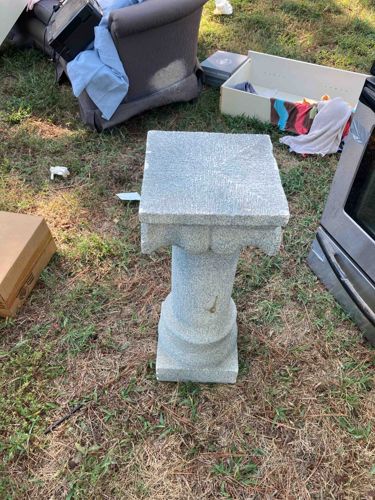
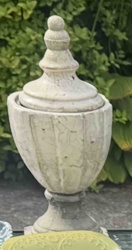
This item is a garden pedestal constructed from a speckled, light grey granite-like material, possibly concrete with a granite aggregate finish, giving it a rough, textured appearance. The pedestal features a square top surface, approximately 12-15 inches per side based on its apparent size relative to the surrounding objects, which is also textured. Beneath the top, there is a detailed capital, exhibiting a carved, rounded molding with a series of small, semicircular protrusions or bead-like embellishments along its lower edge, suggesting a classical or neoclassical influence. The central shaft of the pedestal is fluted or tapering in a classical column style, transitioning from a slightly broader top to a narrower waist before expanding again towards the base. The base is also square and substantial, providing stability. The overall height appears to be around 2-3 feet. The visible condition suggests it has been outdoors, with some minor dirt accumulation and possibly some moss or lichen beginning to form in crevices, though this is not clearly visible. There are no obvious chips, cracks, or significant damage, indicating durable construction. The craftsmanship appears competent, with consistent texture and well-defined decorative elements. No specific manufacturer's marks or signatures are discernible from the image. Its style suggests it could be a relatively modern piece designed to emulate classical garden statuary or architectural elements, likely dating from the late 20th century to the present. The material is heavy and weather-resistant, typical for outdoor use.
AI Appraisal Report
Based on my visual examination of the provided image, this granite garden pedestal appears to be in very good condition. There are no obvious chips, cracks, or significant structural damage visible. The textured, speckled, light grey material, likely concrete with granite aggregate, is consistent with durable outdoor use. The craftsmanship is competent, displaying well-defined decorative elements like the rounded molding and bead-like embellishments on the capital, and the classical fluted shaft. Its overall aesthetic suggests a late 20th-century to contemporary production, emulating classical garden architectural elements.
Market conditions for garden pedestals of this type indicate moderate demand, particularly for weather-resistant materials and classical designs. Comparables typically sell in the range of $100-$300, depending on size, material quality, and design intricacy. This piece, with its good condition and classic styling, falls squarely within that range. It is not particularly rare; similar concrete or cast stone pedestals are widely available. Factors impacting its value positively are its robust material and good preservation, while its commonality and lack of discernible provenance or age limit higher valuation.
It is crucial to note the limitations of valuing an item solely from an image. I cannot definitively confirm the exact material composition (e.g., natural granite versus concrete aggregate), precise weight, or detect subtle surface imperfections, hairline cracks, or repairs that might be present. An in-person examination would allow for a tactile assessment of material, confirmation of structural integrity, and a more thorough inspection for minute flaws. Provenance documentation could, for example, reveal a designer or manufacturer, potentially increasing its collectible value, but none is suggested here.