AI estimate as of December 4, 2025 · verify with a professional before acting
AI-Generated · Verify before acting
Everything on this page is generated by AI for informational purposes only. AI can make mistakes — the AI may misidentify items or misattribute them (artist, maker, brand, designer, origin, era). This is not an official valuation and should not be used for insurance, sale, tax, estate, legal, or lending purposes — or any decision requiring a certified appraisal. It is not an authoritative claim about any person, brand, or rights holder — do not share or rely on it as a factual statement about a third party. Always consult qualified professionals before making financial decisions.
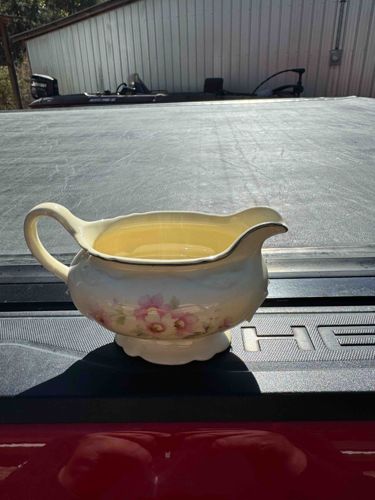
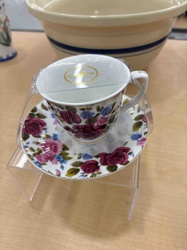
This item is a vintage porcelain gravy boat, characterized by its elegant and functional design. It features a muted ivory or light yellow base color, typical of older ceramic wares, providing a warm and inviting aesthetic. The gravy boat is adorned with a delicate floral motif, specifically pink and white roses with green foliage, hand-painted or decal-applied around the lower body and sides. The rim and the handle of the boat are accented with a thin line of gold trim, adding a touch of sophistication and highlighting its refined craftsmanship. The overall shape includes a broad pouring spout on one end and a gracefully curved handle on the opposite side, designed for ease of grip and serving. It stands on a fluted or scalloped pedestal base, elevating the piece and contributing to its decorative appeal. While specific dimensions are not provided, it appears to be of a standard size for serving gravy or sauces. There are no readily visible chips, cracks, or significant wear on the exterior or interior glaze, suggesting it has been well-preserved or carefully used. The interior of the well appears to be a solid, slightly darker yellow or cream. The style suggests it likely dates from the early to mid-20th century, possibly from the Art Deco or Mid-Century Modern transitional period, given the delicate floral design and gold accents. The quality of the porcelain and the application of the decorative elements indicate a mass-produced but quality item from a period when such tableware was highly valued. There are no discernible manufacturer's marks or signatures visible in the provided image.
AI Appraisal Report
Based on my visual examination of the provided image, this vintage porcelain gravy boat presents in excellent condition. I observe no obvious chips, cracks, or significant wear to the delicate floral motif of pink and white roses, or the gold trim. The muted ivory/light yellow base color and the general design suggest an origin in the early to mid-20th century, likely from the mass-produced, quality tableware era. The gold trim, broad pouring spout, and scalloped pedestal base contribute to its decorative appeal.
Market conditions for vintage gravy boats, even well-preserved ones, are generally moderate. While charming, they typically do not command very high prices unless associated with a sought-after pattern, renowned manufacturer, or significant historical provenance. Comparables for similar floral-decorated, gold-trimmed porcelain gravy boats from this period tend to fall into the $20-$50 range, depending on condition and specific design elegance.
Several factors impact value. The excellent condition is a strong positive. However, the lack of discernible manufacturer's marks significantly limits demand and rarity. Without a known maker, it's considered a generic vintage item rather than a collectible piece from a specific pottery. If it were part of a larger set or had a desirable maker's mark (e.g., Limoges, Haviland, etc.), the value would increase substantially.
My assessment of authenticity is limited by examining images alone. For full authentication and a more precise valuation, I would need a physical inspection to check for subtle hairline cracks, crazing in the glaze, manufacturing imperfections, and to search for any faint maker's marks, impressed or backstamped, that might not be visible in photographs. Provenance documentation, though unlikely for an item of this type, would also be beneficial to confirm its age and origin.