AI Appraisal Estimate

AI-generated estimates · not official valuations

From the user

What was submitted

Photo and notes provided by the user — not generated by AI

Submitted item photo
Submitted photo · June 25, 2026

User's notes

No additional notes provided.

AI analysis below

AI appraisal

AI analysis & estimate

AI-Generated · Verify before acting

Everything below is generated by AI for informational purposes only. AI can make mistakes — the AI may misidentify items or misattribute them (artist, maker, brand, designer, origin, era). This is not an official valuation and should not be used for insurance, sale, tax, estate, legal, or lending purposes — or any decision requiring a certified appraisal. It is not an authoritative claim about any person, brand, or rights holder — do not share or rely on it as a factual statement about a third party. Always consult qualified professionals before making financial decisions.

Read the full disclaimer

AI Identification

·Not independently authenticated·Verify before acting

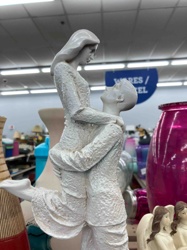
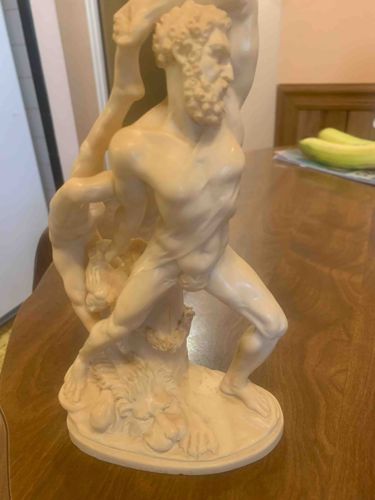
Hercules and the Nemean Lion Sculpture

Sculpture

AI Estimated Value

·Not an official valuation·Verify before acting

$300-500

As of June 25, 2026

AI Item Analysis

·AI can make mistakes·Verify before acting
This appears to be a sculpture depicting Hercules wrestling the Nemean Lion, a classic scene from Greek mythology. The sculpture is made from a light-colored material, likely marble, alabaster, or a resin composite designed to mimic stone, given its creamy off-white hue and smooth finish. The figure of Hercules dominates the composition, portrayed as a muscular, bearded man with curly hair, captured in a dynamic pose of intense struggle. He is shown grappling with the lion, whose body is integrated into the base and surrounds the hero's legs and midsection. The lion's head is visible near Hercules's right leg. The details of the musculature on Hercules are well-defined, suggesting an anatomical understanding, and his facial features, including his beard and hair, are intricately carved with texture. The overall size appears substantial enough to be a prominent decorative piece, likely a tabletop or mantel sculpture. The condition seems good, with no obvious chips, cracks, or significant damage visible from the provided images, though a full inspection would be needed to confirm. There is a slight sheen to the surface, which could indicate a polished finish or the material itself. The style is classicist, reflecting a traditional interpretation of mythological subjects often found in 19th or 20th-century decorative arts. Without a discernible maker's mark or signature, pinpointing the exact origin or age is challenging, but its aesthetic aligns with reproductions of classical art.
AI Appraisal Report

·AI can make mistakes·Verify before acting
I have examined the image of this Hercules and the Nemean Lion sculpture. The piece appears to be in good overall condition, with no immediate visual signs of chips, cracks, or significant damage. The detailed musculature and facial features suggest a competent level of craftsmanship. Based on the creamy off-white hue and smooth finish, the material is likely marble, alabaster, or a high-quality resin composite designed to emulate stone. Without a physical inspection, distinguishing definitively between these materials is not possible. Physical examination would involve tactile assessment and possibly a scratch test or specific gravity measurement for definitive material identification. The style is classicist, indicative of decorative arts from the 19th or 20th century, likely a reproduction or interpretation of classical themes. The absence of a visible maker's mark or signature makes authenticating its origin or age challenging solely from images. Market conditions for mythological sculptures of this type are generally stable for decorative pieces. Comparables typically fall into the lower to mid-range for well-executed reproductions. Demand for such pieces is moderate, primarily from individuals seeking classical aesthetic elements for interior decoration. Rarity is low, as these themes were widely replicated. The primary factor impacting value is the material composition; a genuine marble or alabaster piece would command a higher value than resin. Other factors include the artist's identity (if known), provenance, and the actual age. For full authentication and to ascertain the exact material, an in-person examination by a conservator or art historian, along with potential scientific testing (e.g., spectrophotometry for material analysis, or thermoluminescence for age if ceramic/terracotta, though unlikely here), would be necessary. Documentation of provenance, if available, would also significantly aid in determining authenticity and historical context.

Get your items appraised

Instant estimates of your treasures with AI-powered appraisals

Browse More Appraisals