These notes were written by the person who submitted this item. Appraiser.AI has not verified them, and the AI's identification and estimate may rely on them.
AI Estimated Value
Not an official valuation
$150-250
AI estimate as of September 27, 2025 · verify with a professional before acting
AI-Generated · Verify before acting
Everything on this page is generated by AI for informational purposes only. AI can make mistakes — the AI may misidentify items or misattribute them (artist, maker, brand, designer, origin, era). This is not an official valuation and should not be used for insurance, sale, tax, estate, legal, or lending purposes — or any decision requiring a certified appraisal. It is not an authoritative claim about any person, brand, or rights holder — do not share or rely on it as a factual statement about a third party. Always consult qualified professionals before making financial decisions.
This analysis also relies on unverified notes provided by the user, which may be incomplete or inaccurate and could affect the result.
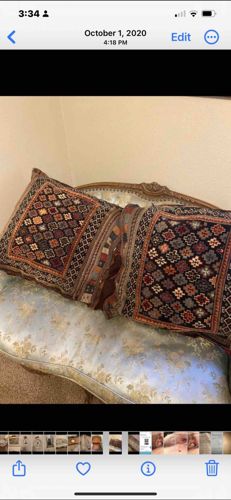
This item consists of a pair of decorative cushions, each featuring a prominently woven kilim-style front. The cushions appear to be rectangular or square in shape, likely intended for use as throw pillows on a sofa or bench, as depicted. The primary material for the front face is a woven textile, characterized by geometric patterns in a rich and earthy color palette. Dominant colors include various shades of brown, black, cream, rust-orange, and some muted blues or grays, creating a striking contrast. Each cushion prominently displays a central field filled with repetitive diamond or stylized floral motifs arranged in a grid-like fashion. This central field is framed by a border with smaller, intricate geometric designs. The weaving technique suggests a flat-weave method, typical of kilims, which contributes to their durable and somewhat rigid texture. The sides of the cushions, visible between the two main pieces, show a transition fabric that seems to be a woven band or strip, possibly made of a similar material but with different, more linear patterns, suggesting these might be repurposed textiles like camel saddle bags, as hinted by the context. There are no clear maker's marks or signatures visible. The overall condition appears good, with some subtle wear consistent with use and age, contributing to a desirable patina rather than severe damage. The craftsmanship appears to be of good quality, with tight weaving and well-defined patterns, indicative of traditional textile artistry. Based on the style and weaving, these cushions likely date from the mid-to-late 20th century or possibly earlier, drawing inspiration from tribal or nomadic textile traditions.
AI Appraisal Report
Upon examining the provided image and information regarding these 'Pair of Woven Kilim-Style Decorative Cushions,' I assess them to be well-crafted examples of decorative textiles. The kilim-style flat-weave, with its earthy color palette and geometric patterns, is consistent with traditional tribal or nomadic textile artistry, potentially repurposed from items like camel saddle bags as suggested. The condition appears good, showing subtle wear that adds to their character rather than detracting from their appeal, which is desirable in such pieces. The tight weaving and defined patterns indicate good quality craftsmanship.
Market demand for decorative kilim textiles and cushions is generally stable, especially for authentic vintage pieces. While these cushions clearly draw inspiration from traditional kilims, without a tactile examination, it's difficult to ascertain the exact age or origin. The term 'kilim-style' suggests they may be reproductions or adaptions rather than antique, hand-woven kilim sections. For a full authentication, in-person examination to assess weave quality, fiber content, and dye analysis would be crucial. Provenance documentation, if available, would significantly enhance authenticity verification.
Comparable items, such as vintage kilim throw pillow covers or cushions, typically range from $75 to $150 each, depending on size, actual age, and provenance. Given these appear to be a matching pair and in good decorative condition, I would place their cumulative appraisal value in the range of $150-250. This accounts for their aesthetic appeal and perceived quality, while acknowledging the limitations in definitively determining age and origin from images alone.