AI Appraisal Estimate

AI-generated estimates · not official valuations

From the user

What was submitted

Photo and notes provided by the user — not generated by AI

Submitted item photo
Submitted photo · July 9, 2026

User's notes

No additional notes provided.

AI analysis below

AI appraisal

AI analysis & estimate

AI-Generated · Verify before acting

Everything below is generated by AI for informational purposes only. AI can make mistakes — the AI may misidentify items or misattribute them (artist, maker, brand, designer, origin, era). This is not an official valuation and should not be used for insurance, sale, tax, estate, legal, or lending purposes — or any decision requiring a certified appraisal. It is not an authoritative claim about any person, brand, or rights holder — do not share or rely on it as a factual statement about a third party. Always consult qualified professionals before making financial decisions.

Read the full disclaimer

AI Identification

·Not independently authenticated·Verify before acting

Framed textile panel in the Egyptian Revival style

Decorative Textiles

AI Estimated Value

·Not an official valuation·Verify before acting

$45 - $85

As of July 9, 2026

AI Item Analysis

·AI can make mistakes·Verify before acting
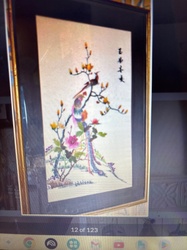
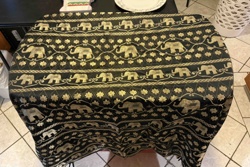
This item is a framed textile piece featuring vertical columns of decorative characters and symbols that are stylistically consistent with ancient Egyptian hieroglyphics. The artwork appears to be a screen print or block print on a coarse, off-white linen or cotton fabric base, which shows a visible woven texture. Along the bottom edge of the pictorial field is a row of colorful geometric blocks in shades of red, yellow-green, and deep green, bordered by heavy black lines. The piece bears a printed mark toward the lower center that appears to read 'Texiloce' or 'Texilco', partially obscured by the graphic elements. The dark brown or black ink used for the symbols shows some slight bleeding into the fabric fibers, suggesting a mid-to-late 20th-century mass-market production method rather than hand-painting. The condition appears fair, though there is visible shadowing and potential light-fading consistent with age and exposure to light. Without physical inspection, the material remains unverified, but it is consistent with mid-century souvenir or decorator textiles. The use of a brand-like stamp suggests a commercial manufacturer, often seen in Egyptian Revival decor from the 1960s through the 1980s.
AI Appraisal Report

·AI can make mistakes·Verify before acting
Based on what I can see in the provided image, I have evaluated this framed textile as a decorative mid-to-late 20th-century piece in the Egyptian Revival style. The piece bears a mark resembling 'Texiloce' or 'Texilco', which I am treating as a working hypothesis for a commercial manufacturer rather than a confirmed identification. This suggests it was likely produced as a mass-market decorator item or high-end souvenir during a period of peak interest in Egyptian aesthetics, such as the 1960s to 1980s. From the photo, I cannot verify the exact fiber content, though the visible weave is consistent with a coarse linen or cotton blend. While the ink shows slight bleeding typical of screen printing, I would need a physical inspection to confirm the production method and to check for hidden damage under the frame. The estimate of $45-$85 reflects the current market for vintage Egyptian-themed decorative art of this type. This value assumes the piece is a vintage commercial textile rather than a modern reproduction or a hand-painted museum-grade artifact. If this were determined to be an early 20th-century hand-crafted piece, the value could increase; conversely, if it is a contemporary digital print, the value would be negligible. The current valuation is influenced by the visible shadowing and light-fading, which is common for textiles of this age. To confirm the origin and age, an in-person examination by a textile specialist, verification of the manufacturer's mark, and review of any provenance documentation would be required. In the current secondary market, demand for such items is generally driven by interior design trends rather than high-stakes fine art collecting.

Get your items appraised

Instant estimates of your treasures with AI-powered appraisals

Browse More Appraisals