AI estimate as of September 18, 2025 · verify with a professional before acting
AI-Generated · Verify before acting
Everything on this page is generated by AI for informational purposes only. AI can make mistakes — the AI may misidentify items or misattribute them (artist, maker, brand, designer, origin, era). This is not an official valuation and should not be used for insurance, sale, tax, estate, legal, or lending purposes — or any decision requiring a certified appraisal. It is not an authoritative claim about any person, brand, or rights holder — do not share or rely on it as a factual statement about a third party. Always consult qualified professionals before making financial decisions.
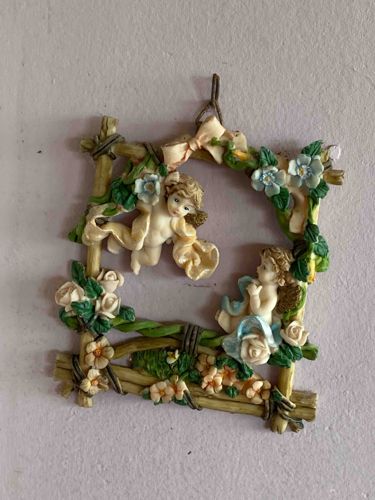
This item is a decorative wall plaque featuring two cherubs amidst a floral and vine-encircled frame. The plaque appears to be composed of resin or a similar polymer, chosen for its ability to capture intricate details and its relatively light weight. Its construction simulates a rustic wooden fence or trellis, with individual 'logs' tied together at the corners, creating a roughly rectangular shape. The dominant colors include various shades of beige and light brown for the frame, vibrant greens for the foliage and vines, and soft pastels for the flowers (light blues, creams, pale oranges/pinks). The two cherubs are depicted with fair skin tones and light brown, curly hair, delicately painted features, and faint angel wings on their backs. The cherub on the left is positioned leaning against the frame, draped in a light, flowing fabric, while the cherub on the right is seated, seemingly in prayer or contemplation, also partially covered by a light blue fabric. A small bow in a peach or light pink color adorns the top center of the frame, tying into the overall gentle aesthetic. There is a metal loop for hanging attached to the top of the frame. While no overt damage or significant wear is immediately visible, without a closer inspection, it's difficult to ascertain if there are any tiny chips, scratches, or fading of paint. The piece appears to be in good general condition. The style suggests a decorative item from the late 20th to early 21st century, often mass-produced for home decor markets, emphasizing a whimsical or angelic theme. The craftsmanship, while detailed, aligns with typical molded resin products, showcasing good detail transfer from a mold rather than hand-carved artistry.
AI Appraisal Report
I have carefully examined the provided image of this Cherub and Floral Wall Plaque. Based on my visual assessment, the item appears to be in good general condition with no immediately visible significant damage such as chips, cracks, or substantial paint loss. The colors remain vibrant, and the details are well-defined. This piece is consistent with mass-produced decorative items from the late 20th to early 21st century, likely crafted from molded resin or a similar polymer. The level of detail transfer suggests good mold quality rather than fine hand-sculpted artistry.
Market conditions for such contemporary decorative wall plaques are generally modest. Comparables in the secondary market, including online marketplaces and thrift stores, show similar resin cherub-themed decor retailing in the low double-digit range. Demand is not high, as these items were widely distributed and are not considered rare. Their value is primarily decorative, appealing to individuals seeking a whimsical or angelic aesthetic for their home.
Factors significantly impacting value include its mass-produced nature and material. While resin allows for intricate detail at an affordable cost, it does not hold intrinsic value like fine art or antique materials. Without an in-person examination, it is impossible to verify authenticity beyond visual cues. A physical inspection would be necessary to detect minor surface imperfections, confirm the exact material composition, and check for any manufacturer's marks, which are often absent on such pieces. Provenance documentation or scientific testing would not typically be applicable or necessary for an item of this type and value due to its decorative purpose and common production methods.