Photo and notes provided by the user — not generated by AI
Submitted photo · June 17, 2026
User's notes
No additional notes provided.
AI analysis below
AI appraisal
AI analysis & estimate
AI-Generated · Verify before acting
Everything below is generated by AI for informational purposes only. AI can make mistakes — the AI may misidentify items or misattribute them (artist, maker, brand, designer, origin, era). This is not an official valuation and should not be used for insurance, sale, tax, estate, legal, or lending purposes — or any decision requiring a certified appraisal. It is not an authoritative claim about any person, brand, or rights holder — do not share or rely on it as a factual statement about a third party. Always consult qualified professionals before making financial decisions.
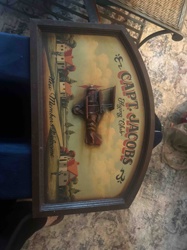
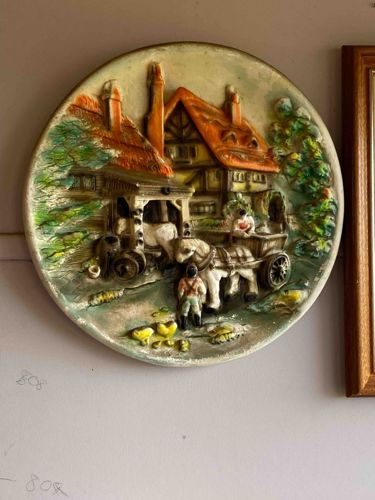
This item is a decorative, circular wall plate featuring a high-relief sculptural scene. The primary subject matter is a quaint village or countryside setting, likely European, centered around a detailed two-story house or inn with a prominent, steeply pitched orange-brown thatched or tiled roof and a large chimney. The architecture suggests a rustic or Tudor-revival style, with visible timber framing on the upper story and a covered porch-like structure extending from the left side of the building. In front of the building, a horse-drawn cart is depicted, with two white horses (possibly grey or dappled given the color variation) harnessed to a brown wooden cart. A human figure, appearing to be a man in a red shirt and light trousers, is standing near the horses, seemingly tending to them or the cart. The foreground features several small yellow figures, possibly ducks or chicks, adding to the pastoral ambiance. Lush green trees and foliage frame the scene on either side and behind the house, suggesting a naturalistic environment. The plate itself has a light, possibly off-white or pale blue-green background color, which serves as the sky and ground for the sculpted elements. The colors used are generally earthy tones – oranges, browns, greens, and whites – giving the piece a warm, inviting feel. The construction is ceramic or a similar composite material, sculpted in relief and then hand-painted or glazed. The dimensionality of the piece is notable, with significant projection from the plate's surface for the buildings, figures, and animals, creating a strong sense of depth. There appears to be some light surface grime or dust accumulation in the crevices, consistent with age and display. No specific manufacturer's marks or signatures are visible in the provided image; however, such pieces were commonly produced as decorative items, particularly from the mid-20th century onwards. The craftsmanship suggests a commercially produced decorative item, designed for aesthetic appeal rather than fine art. The overall condition appears good, with no obvious major chips, cracks, or repairs, though a detailed inspection would be needed to confirm this. The raised elements show particular attention to detail in their modeling.
AI Appraisal Report
·AI can make mistakes·Verify before acting
Having examined the provided image of this Relief Sculptural Wall Plate, I assess its condition as good, with no immediately visible chips, cracks, or repairs. There is some minor surface grime, consistent with age and display but easily cleaned. Authenticity, based solely on visual cues, suggests it is a mid-to-late 20th-century commercially produced decorative item, not fine art. The craftsmanship, while detailed, aligns with mass-produced decor. The absence of visible manufacturer's marks or signatures makes specific attribution impossible without a physical examination.
Market conditions for such decorative relief wall plates are generally moderate. Comparables often include similar ceramic relief pieces depicting pastoral or village scenes, typically found in antique malls or online marketplaces. These items are not rare; many were produced, limiting individual demand. Their value primarily lies in their aesthetic appeal for home decor rather than collectible rarity or artistic significance. Factors impacting value include the good condition and the pleasant, detailed imagery. Without provenance or visible maker's marks, it's challenging to establish any unique attributes that would significantly elevate its worth.
To fully authenticate and confirm the maker, physical examination for hidden marks, material composition analysis (e.g., specific ceramic type), or any accompanying provenance documentation would be essential. From the image alone, I can confidently state it is a charming decorative piece, but not a high-value collectible.