AI estimate as of June 28, 2025 · verify with a professional before acting
AI-Generated · Verify before acting
Everything on this page is generated by AI for informational purposes only. AI can make mistakes — the AI may misidentify items or misattribute them (artist, maker, brand, designer, origin, era). This is not an official valuation and should not be used for insurance, sale, tax, estate, legal, or lending purposes — or any decision requiring a certified appraisal. It is not an authoritative claim about any person, brand, or rights holder — do not share or rely on it as a factual statement about a third party. Always consult qualified professionals before making financial decisions.
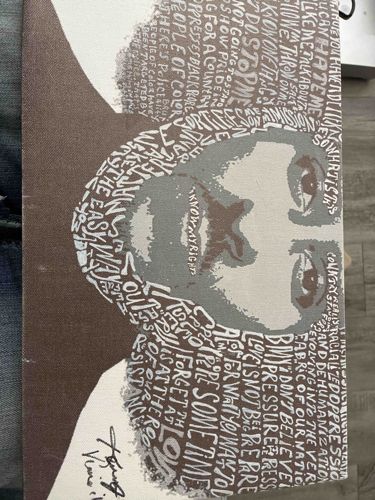
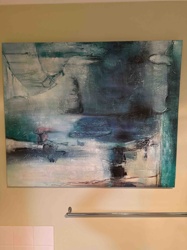
This item is a rectangular canvas print featuring a striking typographic portrait. The dominant colors are muted, primarily consisting of various shades of brown/sepia, light grey, and off-white/cream, which create a compelling monochromatic or duotone effect. The portrait depicts a person, likely male, rendered with an intense, contemplative expression. The most distinctive feature is that the entire visage—including the hair, beard, and facial features—is meticulously composed of tightly packed, varying sizes of written text. The text, rendered predominantly in white against the darker background, is legible in many areas and appears to convey significant social and political messages. Phrases and words discernible within the portrait include "HATE ME," "DO STOP ME," "OPPRESSION," "BLACK PEOPLE," "PEOPLE OF COLOR," "POLICE," "COUNTRY," "LOVE IS NOT," "SOME TIME," "FORGET," and "RESISTANCE," among others. This textual content strongly suggests themes of civil rights, racial justice, and societal struggle, characteristic of contemporary social commentary art. The artwork is a digital print on canvas, a common medium for such works. Physical characteristics include a canvas substrate stretched over a hidden frame (not visible). The size appears to be medium to large, suitable for wall hanging, and the texture of the print accurately replicates the woven nature of the canvas. Visible condition issues include a slight warp or unevenness along the top edge of the canvas and some faint creasing or marks visible on the left side, suggesting possible handling wear or minor tension issues with the canvas stretching. In the bottom left corner, there is a clear handwritten signature in dark ink, which reads "Young" above "Viame," identifying the artist. This piece is likely contemporary art, dating from the late 20th or 21st century, consistent with its themes and digital printing techniques. Its unique method of visual storytelling through typography makes it a distinctive and thought-provoking piece.
AI Appraisal Report
Upon reviewing the detailed description of this Typographic Portrait Canvas Art by Young Viame, I note its striking visual appeal and powerful social commentary. The monochromatic palette and textual composition create an impactful image.
Regarding condition, the description indicates a slight warp along the top edge and faint creasing/marks on the left side. These issues, while minor, detract slightly from the piece's overall presentation and are likely due to handling or tension. Authenticity is suggested by the handwritten "Young Viame" signature in the bottom left. However, without in-person inspection, I cannot definitively confirm this signature's authenticity against verified examples of the artist’s hand or ascertain if it represents a posthumous signature.
In the contemporary art market, prints addressing significant social themes can attract interest. Comparable works would be digital prints on canvas by emerging or mid-career artists, where concept and execution are key. Demand for such thematic works is niche but consistent. Rarity is unknown without information on edition size; as a print, it is unlikely to be one-of-a-kind.
Value is impacted positively by its compelling subject matter and apparent artistic merit. Conversely, its nature as a print (rather than an original work), the noted condition issues, and the lack of an established market for Young Viame, limit its current valuation.
For complete authentication, a physical examination is crucial. This would allow for forensic analysis of the signature's ink and stroke, precise assessment of the canvas material and print quality, confirmation of the exact printing technique, and a thorough evaluation of the condition issues. Crucially, I would need to examine the reverse side for edition numbers, publisher stamps, or any certificates of authenticity. Provenance documentation, detailing the artwork's history of ownership from the artist, is also vital but absent here.