AI estimate as of September 25, 2025 · verify with a professional before acting
AI-Generated · Verify before acting
Everything on this page is generated by AI for informational purposes only. AI can make mistakes — the AI may misidentify items or misattribute them (artist, maker, brand, designer, origin, era). This is not an official valuation and should not be used for insurance, sale, tax, estate, legal, or lending purposes — or any decision requiring a certified appraisal. It is not an authoritative claim about any person, brand, or rights holder — do not share or rely on it as a factual statement about a third party. Always consult qualified professionals before making financial decisions.
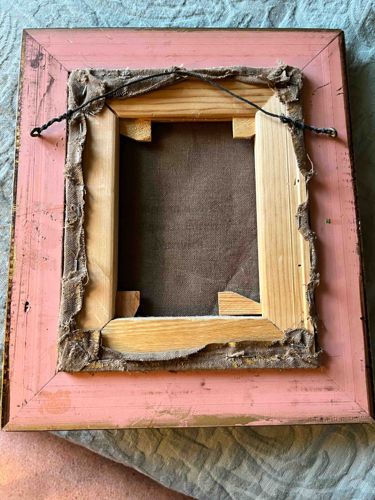
This item is the reverse side of a framed canvas art piece, revealing its construction and framing methods. The frame itself is made of wood, painted in a faded, distressed pink color that shows significant wear, chipping, and areas where the underlying wood or a darker layer is peeking through. This distressed finish suggests either intentional distressing or considerable age and handling. The corners of the frame are mitered and joined, typical for picture frames. Visible on the back are stretcher bars, which are wooden supports forming a rectangular structure that the canvas is stretched over. These stretcher bars appear to be made of light-colored, unfinished wood, likely pine or a similar softwood. The canvas material, visible from the reverse, is a coarse, relatively dark beige or brown fabric, possibly linen or a sturdy cotton, which has been stapled or tacked to the back edges of the stretcher bars. The edges of the canvas are unevenly cut and show fraying, indicative of hand-stretching or a more rudimentary framing process. A black, twisted wire hanger is securely attached to the upper section of the stretcher bars, indicating it is ready for wall display. The overall condition of the back suggests a piece with some age and character, possibly vintage (mid-20th century or earlier) given the visible wear and the somewhat rustic construction.
AI Appraisal Report
I have examined the provided image of the reverse side of a framed canvas art piece. The frame itself, with its faded and distressed pink paint revealing underlying layers and wood, suggests either intentional distressing for a shabby-chic aesthetic or genuine age and wear. The visible stretcher bars are of unfinished light-colored wood, typical for canvas supports. The canvas material appears to be a coarse, dark beige fabric, likely linen or sturdy cotton, stapled to the stretcher bars. The uneven cut and fraying of the canvas edges, along with the overall rustic construction, point to a piece with some age and character, possibly dating to the mid-20th century or earlier. A black twisted wire hanger is securely attached, indicating it is ready for display.
Assessing condition from the reverse, the frame shows significant cosmetic wear consistent with its described finish. The stretcher bars appear stable, and the canvas attachment seems intact. Authenticity in terms of the art itself is entirely undeterminable from this reverse view; I can only assess the framing components. The materials and construction methods are consistent with vintage framed art.
Market conditions for such an item would depend heavily on the art depicted on the front. As a standalone 'reverse view,' its value is minimal. However, considering it as a complete framed artwork (assuming the front holds some aesthetic appeal), its value would fall into the lower-to-mid range for decorative art. Comparables would be other vintage framed canvases with distressed frames. Demand for such an item is generally for decorative purposes rather than as a fine art investment. The 'rarity' of reverse views is not a factor for value.
Factors significantly impacting value are primarily the unknown artistic merit of the front image and the condition of the art itself. Without seeing the artwork, its subject matter, artist, medium, and overall aesthetic quality, any valuation remains highly speculative.
Limitations: Authenticity verification of the artwork itself is impossible from this image. In-person examination would be crucial to assess the artwork's condition, artistic merit, and potential artist's signature. Provenance documentation (prior ownership, exhibition history) or scientific testing (for pigments, canvas fiber analysis) would be needed for full authentication and a precise valuation of the artwork, not just the frame's reverse.