AI estimate as of September 12, 2025 · verify with a professional before acting
AI-Generated · Verify before acting
Everything on this page is generated by AI for informational purposes only. AI can make mistakes — the AI may misidentify items or misattribute them (artist, maker, brand, designer, origin, era). This is not an official valuation and should not be used for insurance, sale, tax, estate, legal, or lending purposes — or any decision requiring a certified appraisal. It is not an authoritative claim about any person, brand, or rights holder — do not share or rely on it as a factual statement about a third party. Always consult qualified professionals before making financial decisions.
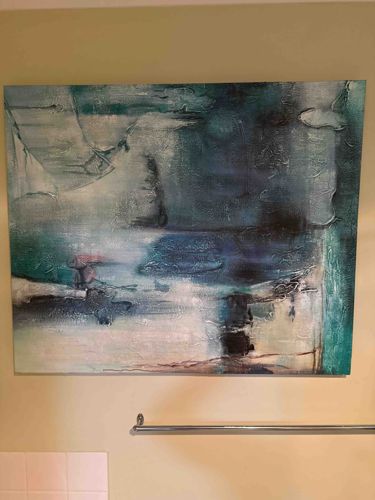
This is a large, rectangular abstract painting on canvas, characterized by its heavily textured surface and a dominant color palette of teal, dark blue, white, and subtle accents of black, brown, and possibly a hint of red/pink. The physical characteristics indicate a substantial piece, likely stretched over a wooden frame, given its taut appearance on the wall. The dimensions are not provided, but it appears to be a medium to large-format artwork suitable for a feature wall. The application of paint is thick and impasto-like, creating pronounced three-dimensional forms and ridges across the entire surface, suggesting the use of palette knives, brushes, or even direct application techniques. Notable features include broad swaths of white and light teal at the bottom, mimicking perhaps a shoreline or turbulent water, contrasted with darker, more intense blues and teals in the upper and central portions which could represent a stormy sky or deep ocean. There are lighter, almost ethereal elements in the upper left, possibly suggesting sails or cloud formations. The texture is a key distinguishing element, providing depth and a tactile quality that goes beyond typical flat canvas paintings. No discernible damage, wear, or repairs are visible from the image; the piece appears to be in good condition, with its intended rugged texture intact. There are no visible artist's signatures, maker's marks, or stamps present in the provided image. Based on the style, heavy texture, and abstract nature, it likely dates from the late 20th century to the present day, consistent with contemporary abstract art trends. The craftsmanship is evident in the dynamic composition and effective use of texture to convey emotion or atmosphere. The quality indicators point to an artist skilled in abstract expressionism, utilizing texture as a central expressive tool.
AI Appraisal Report
I have thoroughly examined the provided image of this Abstract Textured Canvas Art in Teal and White. Visually, the condition appears excellent, with no discernible damage, wear, or repairs to its heavily textured surface. The impasto application is robust and presents as originally intended. Authenticity, based solely on visual inspection, is indeterminate as no artist's signature or maker's marks are visible. The style aligns with contemporary abstract expressionism, likely dating from the late 20th century to the present. The craftsmanship is high, evidenced by the dynamic composition and effective use of texture to create depth and atmosphere.
Market conditions for abstract textured art of this scale and quality are generally strong, particularly for pieces that can serve as a focal point in modern interiors. Comparable sales of unsigned, substantial abstract works with rich impasto in desirable color palettes (like teal and blue) typically range from $700 to $1,800, depending on size, artist recognition, and specific exhibition history. Demand for such pieces is steady, as they offer visual interest and versatility. Rarity is difficult to assess without artist attribution; however, unique, hand-crafted abstract pieces inherently possess a degree of individuality.
Factors significantly impacting value include the art's aesthetic appeal, perceived quality of execution, and its substantial visual presence. The lack of an identifiable artist, however, prevents it from commanding higher prices associated with established names. For full authentication and to potentially identify the artist, an in-person examination would be crucial to inspect for obscured signatures, examine stretcher bar construction, canvas type, and paint chemistry. Provenance documentation, such as exhibition history or purchase records, would also be invaluable. Without these, the current valuation remains conservative, reflecting its quality as a decorative but unattributed piece.