These notes were written by the person who submitted this item. Appraiser.AI has not verified them, and the AI's identification and estimate may rely on them.
AI Estimated Value
Not an official valuation
$5 - $15
AI estimate as of September 23, 2025 · verify with a professional before acting
AI-Generated · Verify before acting
Everything on this page is generated by AI for informational purposes only. AI can make mistakes — the AI may misidentify items or misattribute them (artist, maker, brand, designer, origin, era). This is not an official valuation and should not be used for insurance, sale, tax, estate, legal, or lending purposes — or any decision requiring a certified appraisal. It is not an authoritative claim about any person, brand, or rights holder — do not share or rely on it as a factual statement about a third party. Always consult qualified professionals before making financial decisions.
This analysis also relies on unverified notes provided by the user, which may be incomplete or inaccurate and could affect the result.
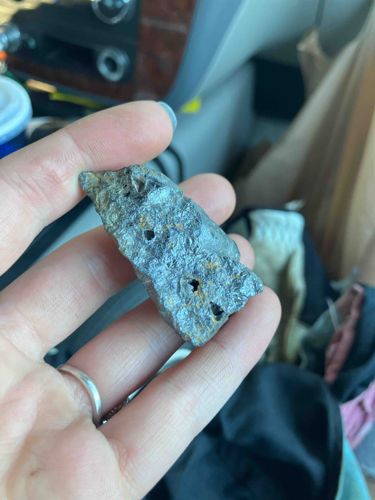
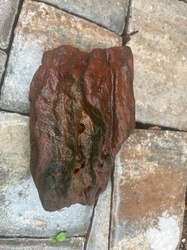
The item appears to be a fragment of a metallic mineral or industrial slag, held in an individual's hand. Its approximate size is consistent with fitting comfortably within the palm, likely a few inches in length and width. The predominant color is a dark, silvery-gray metallic hue, with observable areas of rusty brown or reddish-brown oxidation, suggesting the presence of iron. The surface is highly irregular and rugged, displaying a rough, unpolished texture with numerous pits, crevices, and angular projections. Several distinct, roughly circular or irregular holes or indentations are visible on its surface, indicating areas where material might be missing, or gases escaped during formation. These holes vary in size but are generally small, less than a quarter-inch in diameter. The overall form is amorphous, lacking any discernible man-made shape or structure, suggesting a naturally occurring fragment or a byproduct of an industrial process. There are no visible markings, signatures, or manufacturing details, making it difficult to determine its specific origin or age without further testing. The 'silver-like' characteristic is a visual attribute attributable to its metallic luster. The condition appears stable, with the observed 'wear' being inherent to its natural or formative state, rather than damage from use. The presence of oxidation points to exposure to environmental elements over time. The craftsmanship is not applicable as it does not appear to be an artifact of human design.
AI Appraisal Report
Based on my visual examination of the provided image, the item appears to be a metallic mineral fragment or, more likely, a piece of industrial slag. The dark, silvery-gray metallic color with significant rusty brown oxidation strongly suggests the presence of iron, possibly as iron ore or, more probable given the irregular porous structure, a byproduct from smelting operations. The rough, unpolished texture with numerous pits and holes is characteristic of slag formation where gases escape during cooling. The amorphous shape further supports this. The owner's description of it as a 'silver-like stone' refers to its metallic luster, but it is not silver.
Authenticity, in this case, refers to whether it is a natural mineral specimen or industrial slag. Without physical examination, including density testing and potentially elemental analysis (e.g., XRF), I cannot definitively distinguish between a naturally occurring metallic mineral fragment (like hematite or magnetite ore, though the porosity leans away from this) and slag. However, the highly irregular, porous nature is most consistent with slag. Slag is a common industrial byproduct and generally holds very little monetary value unless it possesses exceptional aesthetic qualities or is historically significant, which this piece does not appear to be.
Market conditions for such items are very limited. Collectors of natural mineral specimens typically seek well-formed crystals or rare compositions. Slag, while sometimes collected for its unique forms, does not command significant value. Demand for common metallic fragments or slag is minimal. Rarity is not a factor here; items resembling this are abundant globally. Factors significantly impacting value would include conclusive identification as a rare native metal, a historically significant piece of early metallurgy, or an extremely aesthetically pleasing natural formation – none of which can be confirmed visually.
Therefore, based on my assessment as likely industrial slag, I appraise this item from $5 to $15. This value reflects its novelty as an interesting curiosity rather than any inherent material worth or rarity. A definitive determination would require in-person inspection and potential lab testing.