AI Appraisal Estimate

AI-generated estimates · not official valuations

From the user

What was submitted

Photo and notes provided by the user — not generated by AI

Submitted item photo
Submitted photo · June 6, 2026

User's notes

No additional notes provided.

AI analysis below

AI appraisal

AI analysis & estimate

AI-Generated · Verify before acting

Everything below is generated by AI for informational purposes only. AI can make mistakes — the AI may misidentify items or misattribute them (artist, maker, brand, designer, origin, era). This is not an official valuation and should not be used for insurance, sale, tax, estate, legal, or lending purposes — or any decision requiring a certified appraisal. It is not an authoritative claim about any person, brand, or rights holder — do not share or rely on it as a factual statement about a third party. Always consult qualified professionals before making financial decisions.

Read the full disclaimer

AI Identification

·Not independently authenticated·Verify before acting

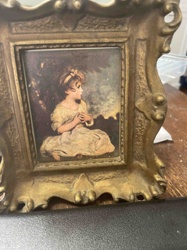
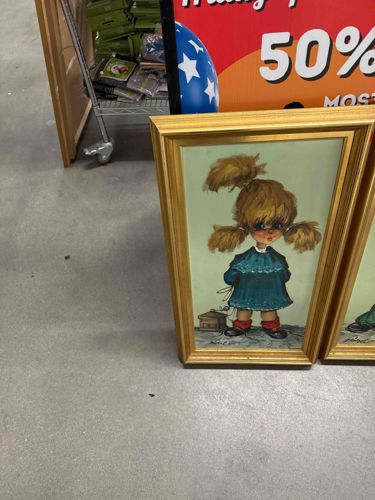
Vintage Igor Pantuhoff Style 'Big Eye' Girl Lithograph in Gilt Frame

Vintage Art and Decor

AI Estimated Value

·Not an official valuation·Verify before acting

$45 - $85

As of June 6, 2026

AI Item Analysis

·AI can make mistakes·Verify before acting
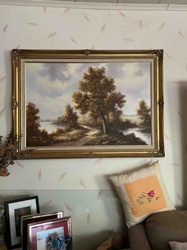
This is a vintage vertical rectangular artwork depicting a young girl in the 'Big Eye' kitsch style popular in the mid-20th century, specifically reminiscent of the works by Igor Pantuhoff. The piece shows a young girl with exaggerated proportions, featuring large, expressive eyes partially obscured by blonde, flyaway hair styled in pigtails and a top knot. She wears a dark teal or peacock blue dress with lace-like detailing at the hem and collar, red socks, and black shoes. Beside her stands a small wooden music box or case. The background is a soft, muted sage green. The artwork is housed in a decorative, tiered gilt-finish wooden or molded frame with a metallic gold sheen and a thin teal-colored inner border strip that coordinates with the girl's dress. The condition shows signs of age consistent with a vintage mass-produced print. There is some minor scuffing and dust accumulation on the surface of the frame, and the paper/canvas board shows light foxing or spotting, particularly in the upper left background area. The signature at the bottom left appears to be a replica signature commonly found on these mid-century decor prints. Based on the construction and aesthetic, this item likely dates to the late 1960s or early 1970s. The craftsmanship is typical of commercial home decor from that era, designed for affordability and broad appeal during the 'Big Eye' art movement.
AI Appraisal Report

·AI can make mistakes·Verify before acting
Based on my visual examination of the provided imagery, I have assessed this vintage 'Big Eye' lithograph. The piece is a quintessential example of mid-century kitsch decor, specifically mimicking the stylistic hallmarks of Igor Pantuhoff. The subject’s exaggerated features and vibrant yet muted palette suggest a production date between the late 1960s and early 1970s. The frame, featuring a period-correct tiered gilt finish and teal accent, appears original to the piece, which adds to its decorative integrity. The condition is 'fair to good.' I noted visible foxing and spotting on the substrate, particularly in the upper left quadrant, and minor surface abrasions on the frame. As a mass-produced mechanical lithograph rather than an original oil on canvas, its value is driven by the current market demand for 'Mid-Century Modern' (MCM) aesthetics rather than fine art scarcity. Currently, the market for 'Big Eye' art remains steady but is heavily saturated with prints from Turner Wall Accessory or similar decor companies, keeping prices accessible. Limitations: This appraisal is based strictly on digital images. Without a physical inspection, I cannot confirm the substrate material (e.g., paper vs. textured board) or identify UV damage not visible in photos. Full authentication would require removing the backing to inspect for manufacturer stamps, checking for 'dot patterns' under a jeweler’s loupe to confirm printing methods, and verifying the frame construction. Provenance documentation, such as original gallery labels or purchase receipts, would further solidify its history but likely wouldn't significantly shift the value of a mass-produced print.

Get your items appraised

Instant estimates of your treasures with AI-powered appraisals

Browse More Appraisals