AI estimate as of September 10, 2025 · verify with a professional before acting
AI-Generated · Verify before acting
Everything on this page is generated by AI for informational purposes only. AI can make mistakes — the AI may misidentify items or misattribute them (artist, maker, brand, designer, origin, era). This is not an official valuation and should not be used for insurance, sale, tax, estate, legal, or lending purposes — or any decision requiring a certified appraisal. It is not an authoritative claim about any person, brand, or rights holder — do not share or rely on it as a factual statement about a third party. Always consult qualified professionals before making financial decisions.
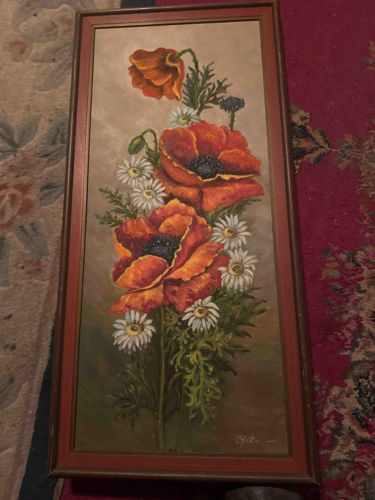
This item is a framed vertical oil painting primarily featuring a vibrant arrangement of red-orange poppies and white daisies against a muted background. The painting depicts at least three prominent poppy blooms with dark centers, showing variations in size and orientation. One poppy appears as a closed bud at the top, while two larger, open blooms dominate the mid-section and lower-mid section. Interspersed among the poppies are clusters of smaller, white daisies with yellow centers, adding contrast and depth to the composition. Green foliage, likely representing poppy leaves and stems, fills the lower and central portions of the canvas. A faint, dark blue or purple, thistle-like flower is visible in the upper right. The painting exhibits a somewhat impressionistic or illustrative style, with visible brushstrokes, particularly in the petals of the poppies, suggesting texture and movement. The color palette is rich, with strong reds and oranges for the poppies, crisp whites and yellows for the daisies, and various shades of green for the foliage, all set against a neutral, possibly brown or beige, background that transitions to a darker green at the bottom. The painting is housed within a simple, red-brown wooden frame, which appears to have a slightly distressed or aged finish. The frame itself shows some signs of wear consistent with age, such as minor scuffs or scratches, particularly visible along its edges. The painting material appears to be oil on canvas or board. In the bottom right corner, a signature is faintly visible, reading 'G.Reka' or 'C.Reka', followed by a dash. The signature's style suggests a mid-20th century or late 20th-century aesthetic. No apparent significant damage like tears or major paint loss is visible from the provided image, though typical light surface dust or grime might be present given its apparent age. The overall condition appears to be good for its age, displaying a natural patina. The craftsmanship suggests a commercially produced decorative piece or an amateur to semi-professional artist's work, designed for general home decor.
AI Appraisal Report
Based on my visual examination of the provided image, this Framed Floral Oil Painting of Poppies and Daisies appears to be in good overall condition for its age, with no significant damage like tears or major paint loss visible. The frame shows minor wear consistent with age, contributing to its decorative appeal. The painting's style, visible brushstrokes, and subject matter suggest it is likely a decorative piece from the mid to late 20th century. The signature 'G.Reka' or 'C.Reka' is intriguing, but without further research or context, it’s challenging to attribute it to a known artist or establish provenance.
In terms of market conditions, items of this decorative nature, even if original oils, typically fall into the general home decor category rather than fine art. Comparables in the secondary market for unsigned or lesser-known decorative oil paintings of floral subjects often range from $50 to $200, depending on size, artistic quality, and framing. Demand for such pieces is steady but not exceptional, as they are widely available. Rarity is not a significant factor here; similar works by unlisted artists are common.
Factors impacting value include its good condition and pleasant aesthetic. However, the lack of a prominent artist, established provenance, or exceptional artistic execution limits its value. Without physical inspection, I cannot confirm the exact medium (oil on canvas vs. board), assess surface grime or subtle imperfections, or definitively verify the signature's authenticity. For full authentication and a more precise valuation, I would require an in-person examination to inspect the brushwork, canvas condition, and thoroughly research the signature, along with any provenance documentation.