AI estimate as of November 28, 2025 · verify with a professional before acting
AI-Generated · Verify before acting
Everything on this page is generated by AI for informational purposes only. AI can make mistakes — the AI may misidentify items or misattribute them (artist, maker, brand, designer, origin, era). This is not an official valuation and should not be used for insurance, sale, tax, estate, legal, or lending purposes — or any decision requiring a certified appraisal. It is not an authoritative claim about any person, brand, or rights holder — do not share or rely on it as a factual statement about a third party. Always consult qualified professionals before making financial decisions.
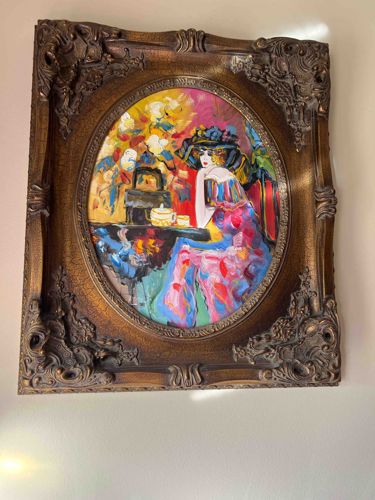
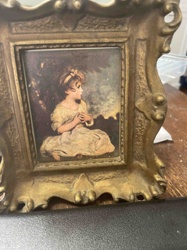
This item is a framed painting depicting a woman seated at a table with tea service, executed in a vibrant impasto style. The painting itself is an oval, featuring highly textured and thick applications of paint, creating a three-dimensional effect. The color palette is very bright and expressive, dominated by blues, pinks, yellows, oranges, and greens, with less prominent areas of black and white. The woman is depicted wearing a wide-brimmed hat and a colorful dress, with a stylized face and visible brushstrokes. Behind her appears to be a backdrop of floral or abstract shapes in contrasting bright colors. The tea service on the table is rendered with similar bold brushwork and color. The painting is encased in an ornate, rectangular frame constructed from what appears to be wood or a resin composite with a bronze or antiqued gold finish. The frame boasts elaborate, rococo-inspired carvings and decorations, particularly noticeable at the corners and along its inner and outer edges, featuring scrolling botanical motifs such as acanthus leaves. The overall condition of the frame appears good, with a visible patina that enhances its antique aesthetic. No significant damage or repairs are immediately apparent on either the painting or the frame, although direct inspection for detailed condition would be necessary. The thick application of paint suggests a modern or contemporary style, likely from the late 20th or early 21st century. The craftsmanship of the frame is robust, providing a regal complement to the expressive artwork.
AI Appraisal Report
Based on my visual examination of the provided image, this framed impasto-style painting of a woman at tea exhibits characteristics that inform its appraisal. The painting itself is presented in an oval format, featuring very thick, sculptural application of paint, creating a strong three-dimensional effect. The vibrant and expressive color palette, dominated by blues, pinks, yellows, oranges, and greens, with a stylized depiction of the woman, suggests a modern or contemporary origin, likely late 20th or early 21st century. The craftsmanship and condition of the painting appear good, with the impasto style inherently masking minor surface imperfections. The ornate rectangular frame, likely wood or resin with a bronze/antiqued gold finish, features elaborate rococo-inspired carvings. Its condition seems good, with an attractive patina, complementing the artwork. No significant damage is immediately apparent on either component.
Market conditions for decorative art of this style can vary. While impasto paintings have a distinct appeal, the lack of an identifiable artist for this piece limits its investment potential. Comparables would include similar decorative oil or acrylic impasto paintings by unknown or emerging artists, often sold through online art markets, galleries specializing in decorative arts, or secondary markets. Demand exists for visually striking pieces that serve a decorative purpose rather than as fine art investments. The robust, decorative frame adds to its overall aesthetic appeal and perceived value.
Limitations regarding authenticity verification from images alone are significant. I cannot verify the medium (oil vs. acrylic), the artist’s identity, or the exact age without direct physical inspection. A full authentication would require in-person examination to assess paint layers, canvas/support type, and any signatures or annotations on the reverse. Provenance documentation would be crucial to establish artist identity and history. Scientific testing of materials could confirm age and medium more precisely. Therefore, this appraisal is based purely on its aesthetic and decorative merit.