These notes were written by the person who submitted this item. Appraiser.AI has not verified them, and the AI's identification and estimate may rely on them.
AI Estimated Value
Not an official valuation
$60-90
AI estimate as of October 25, 2025 · verify with a professional before acting
AI-Generated · Verify before acting
Everything on this page is generated by AI for informational purposes only. AI can make mistakes — the AI may misidentify items or misattribute them (artist, maker, brand, designer, origin, era). This is not an official valuation and should not be used for insurance, sale, tax, estate, legal, or lending purposes — or any decision requiring a certified appraisal. It is not an authoritative claim about any person, brand, or rights holder — do not share or rely on it as a factual statement about a third party. Always consult qualified professionals before making financial decisions.
This analysis also relies on unverified notes provided by the user, which may be incomplete or inaccurate and could affect the result.
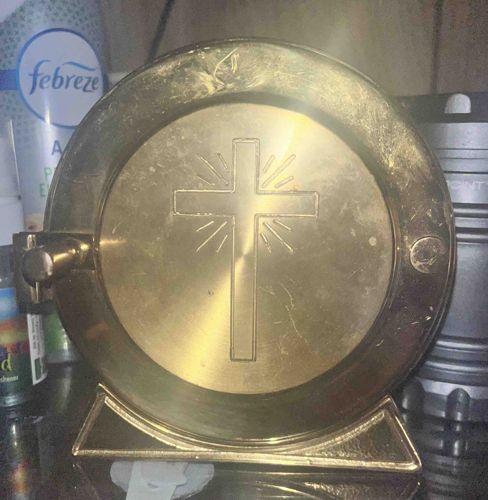
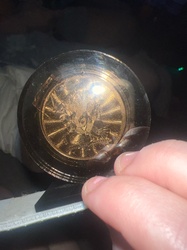
This item is a circular, brass-toned metal religious artifact, likely serving as a luna holder or the base of an ostensorium, specifically designed to display the consecrated host for adoration in Christian liturgical practices. The primary feature on its front face is a deeply engraved or embossed Latin cross, with stylized rays emanating from its center, symbolizing divine light or grace. The cross is centered on a flat, circular plate, which is surrounded by a slightly raised, rounded rim. The overall construction appears sturdy and has a significant, possibly solid, metallic feel. The material exhibits a somewhat aged, dull gold or brass color, with visible signs of wear, specifically numerous scratches and scuff marks across the surface, indicating handling and presence in various environments over time. There are also some darker spots and areas of discoloration, suggesting natural patina development or residue from cleaning attempts. On the left side of the circular plate, there is a protruding cylindrical extension with a slightly flared, knob-like end, which would typically be where the 'luna' (a small, circular container for the host) is inserted and secured. On the right side, there's a smaller, circular indentation or mark that might be an additional decorative element or a functional point. The item is supported by a distinctive triangular or A-frame style base, which is also brass-toned and appears to be integrated into the main circular structure, providing stability for upright display. While no specific maker's marks or signatures are visible in the provided image, the craftsmanship suggests a traditional ecclesiastical item, likely manufactured in the 20th century. The visible wear indicates it has been actively used in religious services or displayed publicly, adding to its character.
AI Appraisal Report
Upon visual examination of the provided images, this item presents as a 20th-century luna holder or the base of a small ostensorium, designed for liturgical use. The material appears to be a brass-toned base metal, consistent with common ecclesiastical furnishings of this era. The design, featuring an engraved cross with emanating rays and an integrated A-frame stand, is traditional and functional. Its condition is fair; while structurally intact, the surface exhibits significant wear, including numerous scratches, scuffs, and areas of discoloration or patina. This indicates a history of active use rather than that of a pristine or highly collectible piece.
From a market perspective, similar vintage, non-precious metal liturgical items are relatively common. Comparables can be found in online marketplaces and ecclesiastical supply resale shops, typically priced in the $50 to $100 range, depending on condition and specific artistry. The demand for such items is specialized, primarily coming from smaller parishes, private chapels, or individual collectors of religious artifacts. Its lack of precious metal content (silver or gold), absence of identifiable maker's marks, and visible wear are the primary factors limiting its value. It is a functional piece of churchware with historical character but not a rare or artistically significant artifact.
It is crucial to note that this appraisal is based solely on images. An in-person examination is necessary to confirm the specific metal composition, assess the depth of the wear, and search for any hidden maker's marks or hallmarks that could alter the value. Without physical inspection, a definitive authentication cannot be performed.