AI estimate as of October 12, 2025 · verify with a professional before acting
AI-Generated · Verify before acting
Everything on this page is generated by AI for informational purposes only. AI can make mistakes — the AI may misidentify items or misattribute them (artist, maker, brand, designer, origin, era). This is not an official valuation and should not be used for insurance, sale, tax, estate, legal, or lending purposes — or any decision requiring a certified appraisal. It is not an authoritative claim about any person, brand, or rights holder — do not share or rely on it as a factual statement about a third party. Always consult qualified professionals before making financial decisions.
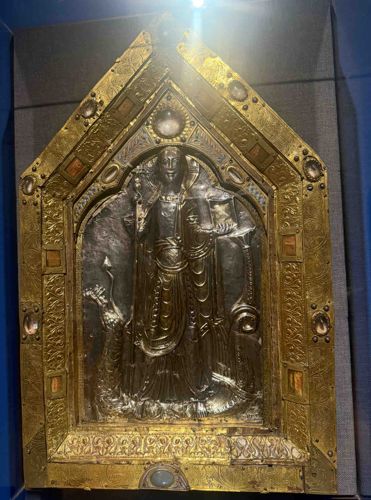
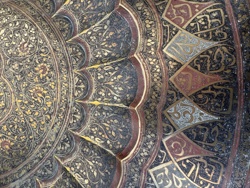
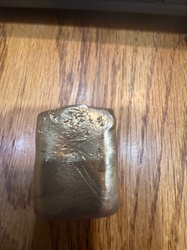
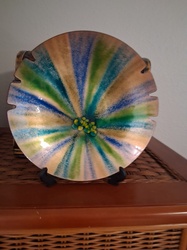
This appears to be a section of a medieval reliquary panel or perhaps part of an altar frontal, characterized by its elaborate craftsmanship and devotional subject matter. The central figure, likely St. Michael the Archangel, is depicted in high relief, possibly in repoussé technique, against a darker, tarnished metal background. He is shown in a standing posture, wearing ornate robes that cascade in elegant folds, holding what appears to be a staff or spear in his right hand and a shield or book in his left. A small, dragon-like creature is visible at his feet, referencing the Archangel's victory over evil. The figure's halo is prominent, and facial features are stylized in a manner typical of medieval religious art. The central panel is framed by a broad, intricately decorated golden border, likely gilded bronze or copper, featuring punched or engraved patterns of foliage and geometric designs. Along the border, small, cabochon-style stones or glass inlays are set, varying in color from white to subtle blue-green, adding to its precious appearance. The frame is secured with visible rivets or small nails, indicating its construction. The overall style suggests a Romanesque or early Gothic period, perhaps 11th to 13th century. The item exhibits significant patina and tarnish consistent with age, particularly on the relief figure, which has a darker, oxidized finish compared to the brighter golden frame. Some areas of the gilt frame show wear, revealing the underlying metal. This piece demonstrates remarkable craftsmanship with attention to detail in both the figural representation and the decorative elements, indicative of high-quality ecclesiastical artistry.
AI Appraisal Report
Based on my visual examination of the provided image, this Medieval Reliquary Panel or Altar Frontal Section featuring Saint Michael is a remarkable piece. The craftsmanship, evident in the high-relief repoussé figure of St. Michael, the intricate golden border with foliage and geometric designs, and the cabochon-style stone inlays, points to a sophisticated workshop, likely Romanesque or early Gothic (11th-13th century). The depiction of St. Michael vanquishing the dragon is a classic iconographic element. The considerable patina and tarnish, particularly on the central figure, and wear on the gilt frame, are consistent with genuine antiquity and prolonged ecclesiastical use. The visible rivets further support its historical construction methods.
From the image alone, I assess its visual condition as good for its age, though an in-person inspection would be crucial to determine structural integrity, precise material composition, and any repairs or restorations. Authenticity, while strongly suggested by stylistic elements and apparent age, cannot be definitively confirmed without physical examination. I'd need to inspect the reverses, test metal compositions, and analyze patination under magnification.
Market conditions for high-quality medieval ecclesiastical art are robust, driven by institutional collectors and discerning private buyers. Comparable items, while rare, can command significant prices. This piece’s rarity, exceptional detailing, and devotional subject matter contribute significantly to its value. Factors impacting value include its age, material quality (likely gilded copper or bronze), and the intactness of its original form. Provenance documentation, if available, would significantly enhance its value by confirming its history and authenticity. Without definitive provenance or in-hand inspection, I estimate a value range of $40,000-$80,000. Full authentication for a precise valuation would necessitate scientific analysis of materials and construction, along with detailed provenance research.