AI estimate as of July 16, 2025 · verify with a professional before acting
AI-Generated · Verify before acting
Everything on this page is generated by AI for informational purposes only. AI can make mistakes — the AI may misidentify items or misattribute them (artist, maker, brand, designer, origin, era). This is not an official valuation and should not be used for insurance, sale, tax, estate, legal, or lending purposes — or any decision requiring a certified appraisal. It is not an authoritative claim about any person, brand, or rights holder — do not share or rely on it as a factual statement about a third party. Always consult qualified professionals before making financial decisions.
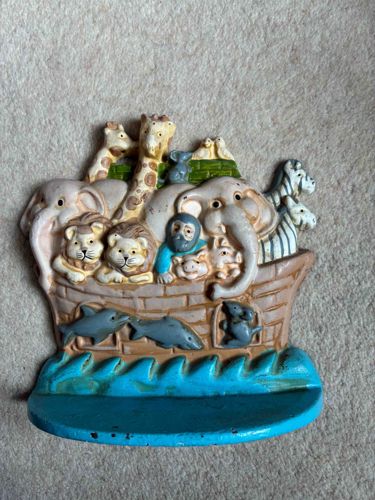
This item is a decorative piece, likely functioning as a bookend, depicting Noah's Ark with various animals. It is crafted from a solid, heavy material, possibly resin or a similar composite, given its molded appearance and the detail achieved. The item features a three-dimensional, carved relief-like rendering of the ark, overflowing with animals. Prominent animals include elephants, giraffes, lions, monkeys, zebras, and several smaller, less distinct animals, possibly pigs or sheep. Below the ark, dolphins and a rat or mouse are depicted in the 'water' section, which is rendered in vibrant blue with stylized waves. The ark itself is a natural brown/tan color, with details resembling wooden planks. The animals are painted in their naturalistic colors: gray for the elephants, spotted yellow/brown for the giraffes, beige/gold for the lions, blue for the monkey, and black and white stripes for the zebras. The overall color palette is bright and cheerful, suggesting a piece intended for a child's room or as a whimsical decor item. The construction appears sturdy, with a broad, flat base in the same teal/blue as the water, designed to provide stability if used as a bookend. There are no visible maker's marks or signatures. The style suggests a contemporary decorative piece, likely from the late 20th or early 21st century. The condition appears to be good, with no obvious chips, cracks, or significant paint loss, though minor surface wear consistent with age and handling might be present upon closer inspection. The craftsmanship is decent, with well-defined animal forms and a clear narrative theme.
AI Appraisal Report
Upon examining the provided image of this Noah's Ark animal figurine/bookend, I assess its condition as good. There are no readily apparent chips, cracks, or significant paint loss visible, suggesting careful handling. The authenticity, based solely on visual examination, appears to be a mass-produced decorative item rather than a unique artisan piece. The details, while clear, lack the nuanced artistry typically found in higher-end collectibles.
Market conditions for such contemporary decorative items, especially those not associated with a known brand or artist, are generally stable but with limited appreciation potential. Comparable items, often made of resin or composite, can be found readily in retail stores specializing in home decor or online marketplaces. Demand for whimsical, themed bookends like this exists, particularly for children's rooms or as novelty gifts, but it is not high enough to drive significant value. The item's lack of rarity, coupled with its likely mass-produced nature, is a significant limiting factor on its value. The absence of maker's marks further suggests it's not from a prominent manufacturer.
Factors impacting value positively include its good condition and charming aesthetic. Negatively, its commonality, lack of provenance, and probable resin composition limit its investment potential. For full authentication and to definitively rule out specific materials or confirm a manufacturer, an in-person examination would be crucial. This would allow for tactile inspection, weight assessment, and microscopic analysis for material confirmation, along with a thorough search for any hidden marks. Provenance documentation, though unlikely for such a piece, would also aid in verifying its origin and history.