AI estimate as of September 24, 2025 · verify with a professional before acting
AI-Generated · Verify before acting
Everything on this page is generated by AI for informational purposes only. AI can make mistakes — the AI may misidentify items or misattribute them (artist, maker, brand, designer, origin, era). This is not an official valuation and should not be used for insurance, sale, tax, estate, legal, or lending purposes — or any decision requiring a certified appraisal. It is not an authoritative claim about any person, brand, or rights holder — do not share or rely on it as a factual statement about a third party. Always consult qualified professionals before making financial decisions.
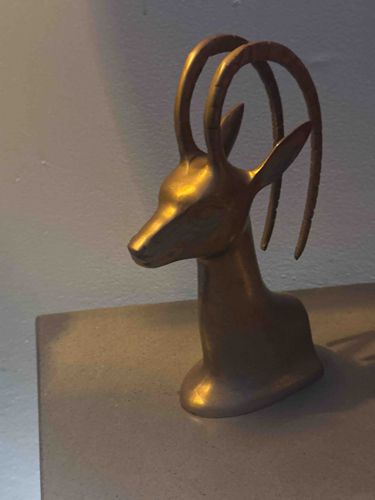
This item is a decorative sculpture depicting the head and neck of a gazelle, likely crafted from brass or a brass-plated metal alloy, given its golden luster and metallic appearance. The surface exhibits a smooth, polished finish with some areas showing a slightly darker patina or possibly remnants of a protective coating, particularly on the base and around the deeper curves of the horns. The color is a warm, rich gold, consistent with aged brass. The gazelle features prominent, elegantly curved horns that arch backward and then slightly forward, characteristic of certain antelope species. Its snout is slender and pointed, and the ears are depicted as small, pointed forms lying close to the head. The neck flows smoothly into a solid, somewhat abstract base, indicating it is likely designed to stand freely on a flat surface, possibly as a decorative accent or a bookend. The overall form is stylized rather than hyper-realistic, emphasizing the animal's graceful lines. There are no obvious signs of significant damage such as dents, cracks, or repairs, though localized wear and minor surface abrasions consistent with age and handling may be present but are not clearly discernible from the provided images. No visible maker's marks, signatures, or stamps are apparent. Based on the aesthetic and material, it likely dates from the mid-20th century, possibly the Art Deco or Mid-Century Modern period, often associated with brass animal figurines for home decor. The craftsmanship appears solid and well-executed, with clean lines and a good casting quality, suggesting a mass-produced decorative item of reasonable quality.
AI Appraisal Report
I have examined the provided image of the Brass Gazelle Head Sculpture or Bookend. Based on its visual characteristics, it appears to be a decorative object, likely brass or brass-plated, displaying a warm golden luster with some minor patina consistent with age. The overall condition appears good, with no obvious major damage such as dents, cracks, or repairs, though localized wear and minor abrasions common with handling would need in-person inspection to confirm. Its stylized form and material suggest a mid-20th-century origin, fitting within the Art Deco or Mid-Century Modern aesthetic, which heavily utilized brass animal figures for home decor. The craftsmanship seems solid, indicating good casting quality for a mass-produced item.
Market analysis for similar vintage brass animal sculptures or bookends, especially those of a stylized nature and without a prominent maker's mark, typically yields values in the $50-$150 range. Pieces with exceptional design, known designers, or significant historical provenance fetch higher prices. Demand for mid-century brass decor remains steady, but common animal forms are not particularly rare. Given the lack of unique features or identifiable artisan work, the rarity factor is low.
Factors impacting value include its good apparent condition and classic stylized design. However, the absence of a maker's mark significantly limits its upper market potential. Without physical examination, I cannot definitively confirm the material (solid brass vs. brass-plated) or assess the tactile quality and weight, which can influence value. Full authenticity would require in-person inspection to verify material composition, detailed surface examination for true condition, and potential XRF testing if material verification were critical. Provenance documentation would also add considerable value, but none is available here.