AI estimate as of October 3, 2025 · verify with a professional before acting
AI-Generated · Verify before acting
Everything on this page is generated by AI for informational purposes only. AI can make mistakes — the AI may misidentify items or misattribute them (artist, maker, brand, designer, origin, era). This is not an official valuation and should not be used for insurance, sale, tax, estate, legal, or lending purposes — or any decision requiring a certified appraisal. It is not an authoritative claim about any person, brand, or rights holder — do not share or rely on it as a factual statement about a third party. Always consult qualified professionals before making financial decisions.
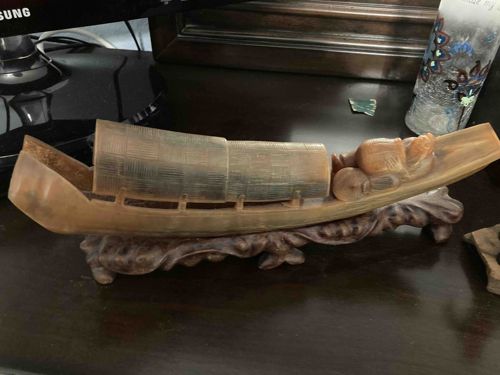
This item is a meticulously carved model of a traditional East Asian junk boat, crafted from a light brown to orange-brown translucent stone, possibly soapstone or a similar soft stone, exhibiting variations in color suggesting natural material. The boat itself is elongated and low-profile, typical of a river or canal vessel. It features a distinct, textured canopy or covered section mid-ship, which appears to be carved with horizontal lines, mimicking the appearance of woven reeds or bamboo matting. On the stern (rear) of the boat, a reclining figure is carved, likely a fisherman or boatman, depicted in a somewhat simplified, stylized manner. The figure has discernible facial features, a torso, and limbs, and appears to be wearing some form of head covering. The entire boat rests on a separate, intricately carved dark brown wooden stand. The stand features sinuous, organic forms, possibly representing waves or swirling water, or perhaps decorative scrollwork, providing a stable and aesthetically pleasing base. The craftsmanship appears to be detailed, particularly in the carving of the canopy texture and the figure. There are no obvious signs of significant damage, cracks, or repairs visible from the provided images, though a closer inspection would be needed to confirm the absence of minor chips or abrasions. The translucency of the stone suggests a high-quality material often used for decorative carvings. The piece appears to be a decorative art object, possibly from the mid-to-late 20th century, reflecting traditional East Asian motifs and carving styles. The combination of the stone carving and the elaborate wooden stand enhances its collectible appeal.
AI Appraisal Report
This carved stone model junk boat, likely crafted from soapstone or a similar soft, translucent stone, presents as a charming decorative art object. Visually, the condition appears excellent, with no obvious chips, cracks, or repairs evident from the image. The detailed carving of the textured canopy and the reclining figure suggests capable craftsmanship. The organic, sinuous dark wood stand complements the boat beautifully and appears robust. Authenticity, based solely on visual examination, points towards a mid-to-late 20th-century East Asian origin, consistent with similar decorative carvings produced for export and local markets.
Market conditions for such decorative stone carvings are generally stable but not experiencing significant surges in value. Demand exists among collectors of Asian decorative arts and those seeking unique display pieces. While not exceptionally rare, well-preserved examples with intricate details like this one, especially when paired with an attractive custom stand, hold a better market position than simpler versions. The translucent stone is a positive factor, indicating a nicer quality material.
Factors impacting value positively include the good condition, the detailed carving, and the integral decorative stand. Limitations in authenticity verification are inherent to image-only appraisals; I cannot ascertain the stone type definitively without physical inspection, touch for texture, or scientific testing. Absence of provenance documentation also limits full authentication of age or origin. An in-person examination would allow for closer inspection for minor abrasions, internal flaws in the stone, and confirmation of the stand's material and construction quality, which could slightly refine the value.