AI Appraisal Estimate

AI-generated estimates · not official valuations

From the user

What was submitted

Photo and notes provided by the user — not generated by AI

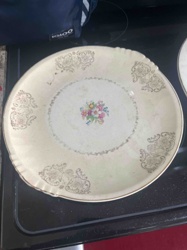
Submitted item photo
Submitted photo · June 25, 2026

User's notes

No additional notes provided.

AI analysis below

AI appraisal

AI analysis & estimate

AI-Generated · Verify before acting

Everything below is generated by AI for informational purposes only. AI can make mistakes — the AI may misidentify items or misattribute them (artist, maker, brand, designer, origin, era). This is not an official valuation and should not be used for insurance, sale, tax, estate, legal, or lending purposes — or any decision requiring a certified appraisal. It is not an authoritative claim about any person, brand, or rights holder — do not share or rely on it as a factual statement about a third party. Always consult qualified professionals before making financial decisions.

Read the full disclaimer

AI Identification

·Not independently authenticated·Verify before acting

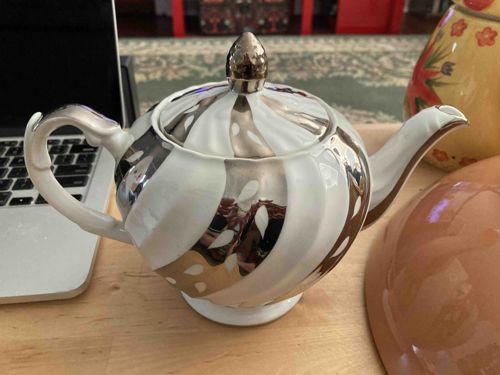
Sadler Silver Lustre Swirl Ribbed Teapot

Vintage Tableware and Ceramics

AI Estimated Value

·Not an official valuation·Verify before acting

$45.00-$75.00

As of June 25, 2026

AI Item Analysis

·AI can make mistakes·Verify before acting
This is a vintage ceramic teapot, likely made by Sadler (England), featuring a distinctive globular body with swirl ribbing. The piece is crafted from white earthenware or porcelain and is heavily decorated with a platinum or silver glaze (lustre) in a wide-banded swirl pattern that alternates with the natural white base. The teapot includes a matching domed lid with a pointed finial, a curved 'C' shaped handle with a thumb rest, and a tapered spout, all accented with silver trim. The lid’s decoration perfectly mirrors the radiating swirl pattern of the body, indicating high-quality construction and alignment. In terms of condition, the silver lustre shows significant reflective depth, though there appears to be minor rubbing or thinning of the metallic glaze on the handle and the edges of the spout, typical of mid-20th-century tea ware. The base is an integrated pedestal foot, which provides stability. Based on the silhouette and the use of 'Lustre' finish, this item likely dates between the 1930s and 1950s, representing the Art Deco or post-war transitional style. There are no visible cracks or chips from the primary angle, suggesting it has been well-maintained as a display or functional piece.
AI Appraisal Report

·AI can make mistakes·Verify before acting
I have conducted a visual examination of the vintage Sadler Silver Lustre Swirl Ribbed Teapot. This piece is a classic example of mid-20th-century British earthenware, likely produced between 1940 and 1955. The 'swirl' or 'gadroon' pattern combined with the platinum luster finish is characteristic of Sadler’s Art Deco-influenced period. Based on my visual inspection, the piece appears authentic; the consistency of the glaze application and the specific shape of the finial and handle are diagnostic of the Staffordshire firm's output during this era. The condition appears Very Good, though close inspection reveals expected age-related wear. The silver lustre shows minor thinning on high-contact areas like the handle and spout, which is common. No structural cracks or significant crazing are visible from the provided angles. Market demand for Sadler tea ware remains stable among 'shabby chic' and mid-century collectors, though the market is currently saturated with silver lustre items compared to more sought-after floral or hand-painted patterns like the 'Cube' series, which limits the ceiling price. Critically, this appraisal is based on photographic evidence only. A final valuation would require physical inspection to check for hidden hairlines, underside 'flea bites,' or professional restorations that are often invisible in photos. I would also need to verify the backstamp (typically the embossed 'SADLER ENGLAND' mark) to confirm the exact production date. For legal authentication, provenance documentation or a vacuum leak test to ensure structural integrity would be necessary if the piece were to be sold as a functional kitchenware item rather than a decorative object.

Get your items appraised

Instant estimates of your treasures with AI-powered appraisals

Browse More Appraisals