AI Appraisal Estimate

AI-generated estimates · not official valuations

From the user

What was submitted

Photo and notes provided by the user — not generated by AI

Submitted item photo
Submitted photo · June 23, 2026

User's notes

No additional notes provided.

AI analysis below

AI appraisal

AI analysis & estimate

AI-Generated · Verify before acting

Everything below is generated by AI for informational purposes only. AI can make mistakes — the AI may misidentify items or misattribute them (artist, maker, brand, designer, origin, era). This is not an official valuation and should not be used for insurance, sale, tax, estate, legal, or lending purposes — or any decision requiring a certified appraisal. It is not an authoritative claim about any person, brand, or rights holder — do not share or rely on it as a factual statement about a third party. Always consult qualified professionals before making financial decisions.

Read the full disclaimer

AI Identification

·Not independently authenticated·Verify before acting

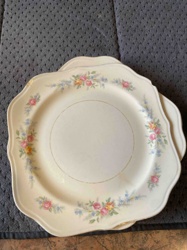
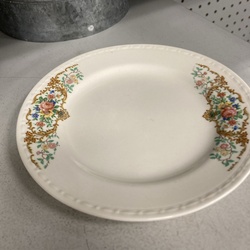
Vintage Floral Patterned Ceramic Serving Platter

Vintage Tableware and Ceramics

AI Estimated Value

·Not an official valuation·Verify before acting

$10.00 - $25.00

As of June 23, 2026

AI Item Analysis

·AI can make mistakes·Verify before acting
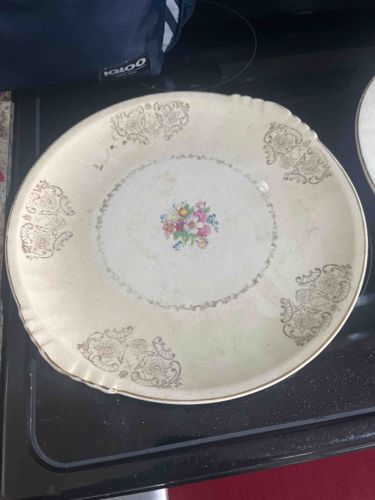
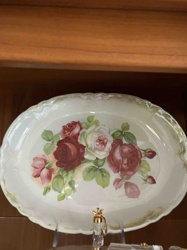
This is a vintage circular ceramic serving platter, likely earthenware or semi-vitreous china, featuring an ivory or cream-colored base glaze. The design includes a center floral bouquet motif in shades of pink, yellow, blue, and green, surrounded by a circular delicate filigree border. The outer rim is decorated with four ornate, symmetrical gold-toned rococo-style scroll sections. The plate or platter features a scalloped perimeter with molded ridges or 'pie crust' edges, a style typical of mid-20th-century American dinnerware manufacturers like Homer Laughlin or Edwin M. Knowles. Regarding condition, the piece shows significant signs of age and use. There is heavy surface crazing (a fine network of cracks in the glaze) across the entire face, along with notable brown staining or 'foxing' where organic materials have seeped into the porous body under the glaze. There are also signs of 'shelf wear' and fading to the gold filigree accents. The quality suggests a mass-produced consumer grade item from the 1940s to 1950s, intended for domestic use rather than fine porcelain collectors. No maker's mark is visible from the front view, but the aesthetic is consistent with the 'American Limoges' or 'Victorian' style patterns popularized during the mid-century period.
AI Appraisal Report

·AI can make mistakes·Verify before acting
I have completed a visual examination of the Vintage Floral Patterned Ceramic Serving Platter. Based on the stylistic markers—specifically the scalloped 'pie crust' rim and the transfer-print floral bouquet—this piece is a mid-20th-century mass-produced item consistent with American potteries like Homer Laughlin or Edwin M. Knowles. While it captures the 'American Limoges' aesthetic popular in the 1940s, it is consumer-grade earthenware rather than fine porcelain. The condition is the primary factor limiting its market value. My inspection reveals heavy surface crazing and significant 'foxing' or brown staining, indicating moisture and organic matter have penetrated the porous ceramic body beneath the glaze. These defects, combined with the visible wear on the gold filigree accents, render the piece unsuitable for food service and relegate it to 'shabby chic' decor or salvage use. In the current secondary market, collectors of vintage dinnerware prioritize 'Near Mint' condition; pieces with this level of crazing and staining are common and hold very little commercial liquidity. This valuation is based on similar sold comparables found in antique malls and online marketplaces for damaged mid-century floral platters. Limitations: This appraisal is based solely on digital images. A physical inspection is necessary to check for hidden hairlines, structural cracks, or a maker's mark on the reverse which could clarify the manufacturer. Without a visible backstamp or provenance documentation, the attribution remains based on stylistic probability. No scientific testing for lead content or glaze stability has been performed, though pieces from this era frequently test positive for heavy metals, further limiting their functional utility.

Get your items appraised

Instant estimates of your treasures with AI-powered appraisals

Browse More Appraisals