These notes were written by the person who submitted this item. Appraiser.AI has not verified them, and the AI's identification and estimate may rely on them.
AI Estimated Value
Not an official valuation
$75-125
AI estimate as of September 18, 2025 · verify with a professional before acting
AI-Generated · Verify before acting
Everything on this page is generated by AI for informational purposes only. AI can make mistakes — the AI may misidentify items or misattribute them (artist, maker, brand, designer, origin, era). This is not an official valuation and should not be used for insurance, sale, tax, estate, legal, or lending purposes — or any decision requiring a certified appraisal. It is not an authoritative claim about any person, brand, or rights holder — do not share or rely on it as a factual statement about a third party. Always consult qualified professionals before making financial decisions.
This analysis also relies on unverified notes provided by the user, which may be incomplete or inaccurate and could affect the result.
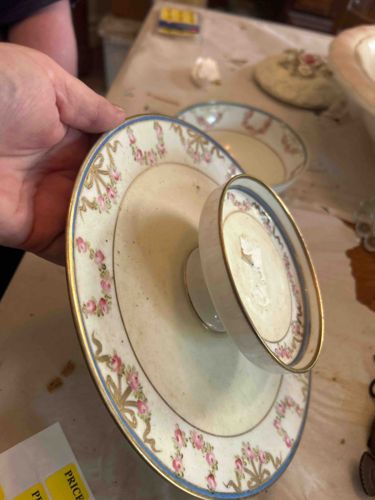
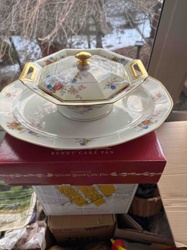
This item is a beautiful and elegant Hand-Painted Porcelain Pedestal Plate, likely originating from the Nippon era (1891-1921), based on the decorative style and common export patterns of that period. It features a circular main plate supported by a raised circular base or foot, creating a pedestal effect. The color palette primarily includes creamy white or ivory porcelain as the base, intricately decorated with delicate pink roses arranged in festoons or garlands. These floral elements are often interspersed with olive-green or gold ribbons and foliage, suggesting a classical or rococo-inspired design. A prominent detail is the thin blue border line delineating the central area from the decorative rim, and both the outer edge of the plate and the rim of the pedestal foot are accented with what appears to be gold gilt. The gold accentuation, while present, shows signs of wear, particularly around the edges, indicating its age and frequent handling or cleaning. The surface of the porcelain exhibits some discoloration and scattered dark spots, possibly dirt accumulation, staining, or fine crazing, which would need further inspection to determine its nature. Despite these visible signs of age, the overall craftsmanship appears to be of good quality, typical of Nippon ware known for its hand-decorated porcelain. The exact size is not discernible without a reference, but it appears to be a dessert or presentation plate. There are no visible maker's marks or signatures in the provided image, though such marks are typically found on the underside of Nippon pieces.
AI Appraisal Report
Based on my visual examination of the provided image, this Nippon Hand-Painted Porcelain Pedestal Plate appears to be an authentic piece from the specified Nippon era (1891-1921). The decorative style, particularly the delicate pink roses, green foliage, and gold accents, aligns well with common motifs found in export porcelain from that period. The presence of a thin blue border line and gold gilt further supports this attribution. The craftsmanship appears good, typical of hand-painted Nippon ware.
Regarding condition, I observe significant wear to the gold gilt, especially on the edges, which is consistent with age and use. There are also visible signs of discoloration, dark spots, and potential crazing on the porcelain surface. These condition issues detract from its overall value. Without a clear view of the underside, I cannot confirm the presence of a maker's mark, which is crucial for definitive attribution and can significantly impact value. The exact size is also unclear from the image.
Market conditions for Nippon porcelain are generally stable, with well-preserved, marked, and rarer pieces commanding higher prices. This specific plate, while charming, falls into a more common decorative category. Similar pedestal plates in good to fair condition typically fetch between $75 and $125. The lack of a visible mark, coupled with condition issues, limits its demand and rarity appeal. For full authentication and a more precise valuation, an in-person examination is essential to inspect for maker's marks, assess crazing/staining, and determine any repairs, which cannot be definitively confirmed from an image alone.