AI Appraisal Estimate

AI-generated estimates · not official valuations

From the user

What was submitted

Photo and notes provided by the user — not generated by AI

Submitted item photo
Submitted photo · May 28, 2026

User's notes

No additional notes provided.

AI analysis below

AI appraisal

AI analysis & estimate

AI-Generated · Verify before acting

Everything below is generated by AI for informational purposes only. AI can make mistakes — the AI may misidentify items or misattribute them (artist, maker, brand, designer, origin, era). This is not an official valuation and should not be used for insurance, sale, tax, estate, legal, or lending purposes — or any decision requiring a certified appraisal. It is not an authoritative claim about any person, brand, or rights holder — do not share or rely on it as a factual statement about a third party. Always consult qualified professionals before making financial decisions.

Read the full disclaimer

AI Identification

·Not independently authenticated·Verify before acting

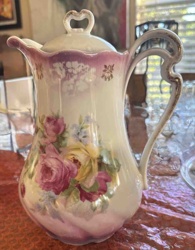
Victorian Era Floral Porcelain Chocolate Pot

Antique Ceramics and Porcelain

AI Estimated Value

·Not an official valuation·Verify before acting

$175.00 - $250.00

As of May 28, 2026

AI Item Analysis

·AI can make mistakes·Verify before acting
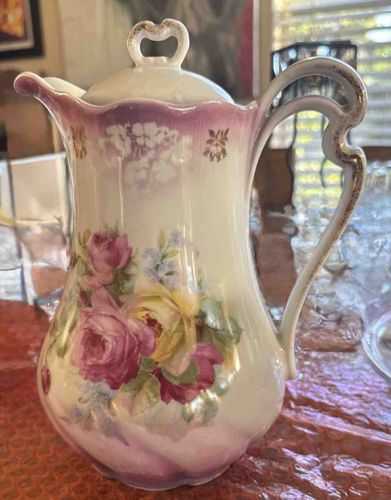
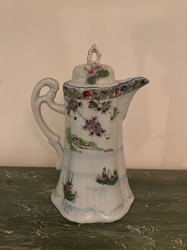
This is an elegant Victorian-style porcelain chocolate or coffee pot, likely dating from the late 19th to early 20th century (circa 1890-1915). The vessel features an elongated, tapered body with a subtle molded swirl or ribbing effect near the base. It is crafted from fine white porcelain and finished with an iridescent pearlescent luster glaze. The central motif consists of a hand-painted or high-quality transfer-decorated bouquet of large cabbage roses in shades of magenta, pink, and yellow, accented with blue forget-me-nots and green foliage. The top rim is characterized by a scalloped edge and a deep violet or lavender airbrushed ombre band, which is further embellished with delicate gold-gilt floral filigree. The handle is an ornate, double-scrolled 'C' shape with significant gold-gilt sponging or wear along the edges. The matching dome-shaped lid features a heart-shaped or looped finial, also touched with gilt. Regarding condition, the piece shows visible wear to the gold gilding on the handle and finial, consistent with age and regular handling. There is a slight patina to the luster finish, though no large cracks or major chips are immediately apparent. This style of decorative porcelain was popular among German and Austrian manufacturers like RS Prussia or Bavarian factories during the Art Nouveau period, characterized by high-quality translucent glazes and romantic floral imagery.
AI Appraisal Report

·AI can make mistakes·Verify before acting
Based on my visual examination of this Victorian-era porcelain chocolate pot, the piece appears to be a genuine example of late 19th-century Continental tableware, likely of German or Austrian origin. The iridescent 'mother-of-pearl' luster glaze and the specific ombre lavender band suggest a production style common to the RS Prussia era or contemporary Bavarian factories. The molded ribbing and hand-accented transfer work are consistent with mass-produced luxury wares of the late 1890s. The condition is fair to good; while the porcelain body remains intact without visible structural fractures, the significant loss of gold-gilt on the double-scrolled handle and finial indicates frequent domestic use, which negatively impacts the value for high-end collectors who prioritize pristine gilding. The current market for late Victorian transfer-ware has seen a softening over the last decade. While historically desirable, younger collectors are moving away from ornate floral porcelains, leading to a surplus of similar chocolate pots at auction. Comparables for unmarked or generic Bavarian pieces typically realize between $150 and $275. If a rare backstamp (such as a 'Red Mark' RS Prussia logo) were discovered, the valuation could increase by 40-60%. Limitations to this appraisal include the inability to check for 'hairlines' that only resonate under a percussion test or to examine the underside for manufacturer marks. A full authentication would require a physical inspection to verify the translucency of the paste and the presence of any professional restoration or 'over-painting' that might be hidden under the luster glaze. Provenance documentation regarding its original purchase or previous ownership would further solidify its historical context.

Get your items appraised

Instant estimates of your treasures with AI-powered appraisals

Browse More Appraisals