AI estimate as of July 7, 2025 · verify with a professional before acting
AI-Generated · Verify before acting
Everything on this page is generated by AI for informational purposes only. AI can make mistakes — the AI may misidentify items or misattribute them (artist, maker, brand, designer, origin, era). This is not an official valuation and should not be used for insurance, sale, tax, estate, legal, or lending purposes — or any decision requiring a certified appraisal. It is not an authoritative claim about any person, brand, or rights holder — do not share or rely on it as a factual statement about a third party. Always consult qualified professionals before making financial decisions.
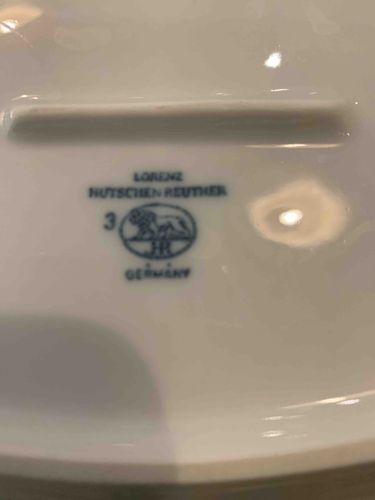
The item is a piece of white glazed porcelain, likely part of a dinnerware or serveware set, as indicated by the presence of a manufacturer's mark typically found on the underside or back of such items. The visible surface is a pristine white, suggesting a clean and classic aesthetic. The material appears to be high-quality porcelain, characterized by its smooth, reflective glaze and inherent durability.
The most prominent feature is the manufacturer's mark, crucial for identification and dating. It is centrally located and rendered in a deep blue underglaze, which suggests it was applied before the final firing and glazing, making it permanent. The mark consists of several elements:
At the top, in a san-serif font, are the words "LORENZ" and below it "HUTSCHEN REUTHER". Below these names, a stylized number '3' is visible to the left. The dominant section of the mark is a circular emblem featuring a lion rampant, standing on its hind legs, with a shield-like element in front of it. Within this shield, the intertwined or stylized letters "HR" are discernible, likely standing for Hutschenreuther. Below the circular emblem, the word "GERMANY" is printed, indicating the country of origin.
No visible condition issues such as chips, cracks, crazing, or significant wear are apparent from the image. The uniformity of the glaze and the crispness of the mark suggest good craftsmanship. Based on the 'Lorenz Hutschenreuther' and 'Germany' markings, this piece likely dates from the 20th century, specifically after the unification of the 'Lorenz' and 'Hutschenreuther' companies and before the significant changes in German manufacturing notations that occurred later in the century. The number '3' might denote a specific mold number, production line, or factory. The quality of the porcelain and the carefully applied mark are indicative of high-standard production. The design is utilitarian, focusing on the quality of the material and the brand identity rather than elaborate decoration.
AI Appraisal Report
I have examined the provided image of this Lorenz Hutschenreuther porcelain item. Based on the visual evidence, the porcelain appears to be in excellent condition, showing no apparent chips, cracks, crazing, or significant wear. The white glaze is uniform and pristine, suggesting it has been well-preserved. The blue underglaze manufacturer's mark, featuring 'LORENZ HUTSCHENREUTHER,' the lion rampant with 'HR' emblem, and 'GERMANY,' is crisp and clearly defined, which is vital for authentication. The '3' likely indicates a mold or pattern number, common in porcelain production.
Authenticity, based solely on the image, appears strong due to the characteristic lion mark and clear branding. However, it's crucial to state that full authentication requires in-person examination to assess the tactile quality of the porcelain, the precise application of the glaze, and to detect any subtle repairs not visible in photographs. Provenance documentation, such as original purchase receipts or family history, would significantly enhance authentication. Scientific testing (e.g., material analysis) is generally not necessary for such items unless there are serious doubts about the period or origin of manufacture.
Market conditions for Lorenz Hutschenreuther porcelain remain steady, particularly for well-preserved pieces from established patterns. This specific item, likely a component of a larger dinnerware or serveware set, holds moderate demand. While individual pieces are not exceedingly rare, a pristine condition enhances its appeal to collectors or those seeking replacements for existing sets. The 'Lorenz Hutschenreuther' and 'Germany' markings place it firmly in the 20th century, likely mid-century. The primary factor impacting value is its condition; the lack of damage greatly increases its desirability.