These notes were written by the person who submitted this item. Appraiser.AI has not verified them, and the AI's identification and estimate may rely on them.
AI Estimated Value
Not an official valuation
$600-900
AI estimate as of November 26, 2025 · verify with a professional before acting
AI-Generated · Verify before acting
Everything on this page is generated by AI for informational purposes only. AI can make mistakes — the AI may misidentify items or misattribute them (artist, maker, brand, designer, origin, era). This is not an official valuation and should not be used for insurance, sale, tax, estate, legal, or lending purposes — or any decision requiring a certified appraisal. It is not an authoritative claim about any person, brand, or rights holder — do not share or rely on it as a factual statement about a third party. Always consult qualified professionals before making financial decisions.
This analysis also relies on unverified notes provided by the user, which may be incomplete or inaccurate and could affect the result.
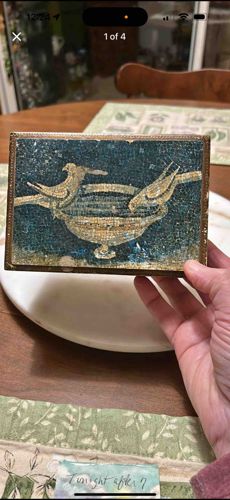
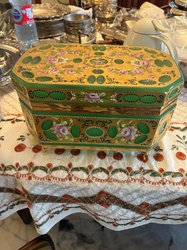
This item is a rectangular wooden box adorned with a finely crafted micromosaic lid. The lid's mosaic depicts two doves drinking from a classical birdbath or chalice-like vessel. The background of the mosaic is primarily a vibrant, deep blue, interspersed with lighter blue and even some darker specks, possibly representing water or sky. The doves and the birdbath are rendered in shades of beige, cream, and light brown tesserae, creating a distinct contrast against the blue. One dove is positioned on the left, looking down into the vessel, while the other dove on the right appears to be drinking from it. The individual tesserae (small pieces of glass or stone) are incredibly small and tightly packed, indicative of micromosaic technique, a hallmark of high-quality mosaic work often associated with Italian craftsmanship. The edges of the mosaic lid feature a thin, darker border, likely made of wood or metal, which frames the artistic composition. The box itself appears to be made of wood, possibly stained to a dark, rich tone, although the sides are only partially visible. The overall condition appears good, with some visible wear and possibly minor losses to the tesserae, particularly around the edges and in some background areas, suggesting age and handling. The patina on the wooden elements also points to an item that has seen some use over time. While no specific maker's marks or signatures are visible in the provided image, the style, subject matter, and intricate detail strongly suggest a 19th or early 20th-century European (likely Italian) origin, a period when micromosaics were particularly popular as souvenir items or decorative objects.
AI Appraisal Report
I have examined the provided image of this Micromosaic Box with Doves and Birdbath Motif. This is a charming decorative box featuring a finely executed micromosaic lid. The subject matter of doves and a birdbath is quite classic for micromosaic work, often symbolizing peace or love, and was a popular theme in 19th and early 20th-century Italian pieces. The deep blue background contrasted with the cream and beige tones of the doves and birdbath is aesthetically pleasing.
Condition appears good given its likely age. I observe some minor wear consistent with handling, and what appears to be very minor losses to tesserae, particularly visible around the edges and within the blue background in certain areas. The wood box itself exhibits a desirable patina. These imperfections are typical for micromosaics of this period and do not significantly detract from its overall appeal or value, rather they attest to its age and use.
From the image, the tightness and small scale of the tesserae strongly suggest authentic micromosaic technique, indicative of Italian craftsmanship. Similar boxes, often from Rome, regularly appear in the market. Demand for Italian micromosaics remains steady, especially for pieces with appealing, well-executed subject matter like this. Rarity is moderate; while micromosaics are not exceedingly rare, a well-preserved example with a desirable motif holds good market interest.
My primary limitation in authentication is the visual nature of this appraisal. For full authentication, I would need a physical examination to inspect the tesserae size, material, and adherence under magnification, and to assess the construction of the wooden box for era-appropriate techniques. Provenance documentation, though not available here, could also solidify its history and origin. However, based on the strong stylistic indicators and detailed imagery, I am confident in attributing this to a 19th or early 20th-century European (likely Italian) origin.
Considering the condition, craftsmanship, and current market for comparable decorative micromosaic boxes, I would place its appraisal value in the range of $600-900.