AI estimate as of November 18, 2025 · verify with a professional before acting
AI-Generated · Verify before acting
Everything on this page is generated by AI for informational purposes only. AI can make mistakes — the AI may misidentify items or misattribute them (artist, maker, brand, designer, origin, era). This is not an official valuation and should not be used for insurance, sale, tax, estate, legal, or lending purposes — or any decision requiring a certified appraisal. It is not an authoritative claim about any person, brand, or rights holder — do not share or rely on it as a factual statement about a third party. Always consult qualified professionals before making financial decisions.
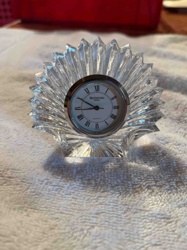
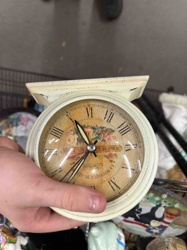
This item is a decorative desk clock, possibly of Chinese origin given the script on its dial, encased in a circular frame. Its physical characteristics include a prominent outer ring featuring a repeating Greek key or 'meander' fretwork pattern, rendered in a silver-toned metal, likely aluminum or silver-plated brass, contrasting with a golden-toned metallic base, suggesting brass or a brass-plated material. The overall construction appears robust and cylindrical, with the clock face recessed within the golden frame. The clock face itself is a light, possibly cream or silver, color with black hands and numerical markings in what appears to be traditional Chinese characters. There are two central hands, one indicating hours and the other minutes, both slender and black, with a small brass-colored cap at their pivot point. The dial shows signs of wear, including smudging, discoloration, and some visible scratches or abrasion, particularly around the center and along the edges, indicating age or frequent handling. The golden frame also shows some tarnishing or patina consistent with metal aging. There are no clear manufacturer's marks or signatures immediately visible in the provided image. The style suggests a blend of East Asian aesthetics (the dial characters) with classical Western design elements (the Greek key pattern), which could place its estimated age anywhere from the late 19th to mid-20th century, or it could be a more contemporary decorative piece designed to evoke an antique feel. The craftsmanship of the fretwork appears precise and detailed, although the condition of the dial could detract from its perceived quality. The specific function of the characters on the dial, beyond telling time, is not discernible without further information; they could represent astrological symbols, traditional time divisions, or other cultural notations. The item has a distinct decorative appeal.
AI Appraisal Report
Based on my visual examination of the provided image, this Chinese Style Desk Clock with Greek Key Fretwork appears to be a decorative item with potential age. Its overall condition is fair to good for a decorative piece, exhibiting notable signs of wear including smudging, discoloration, and scratches on the dial, and some tarnishing or patina on the golden-toned frame. The Greek key fretwork is well-executed, suggesting decent craftsmanship. The blend of East Asian characters on the dial and a classical Western motif like the Greek key pattern makes it visually interesting, but also complex to date definitively from an image alone. Without seeing the movement or any manufacturer's marks, determining its precise age and origin is challenging. It could be an early 20th-century piece, or more recent. The lack of visible identifiers prevents me from authenticating it as a product from a specific maker or period with certainty.
In terms of market conditions, similar decorative desk clocks, especially those of uncertain origin or lacking high-grade movements, generally command modest prices. While the unique design has some appeal, the condition issues and lack of definitive provenance or maker's marks limit its top-tier value. Demand for such mixed-style decorative clocks is moderate. Rarity is difficult to ascertain without knowing the manufacturer; while this specific design may not be ubiquitous, decorative clocks in general are not rare. Factors significantly impacting value are the unknown movement quality, the lack of maker identification, and the visible wear.
For full authentication and a more precise valuation, an in-person examination would be critical to inspect the movement, look for hidden maker's marks or serial numbers, and assess the material composition more accurately. Provenance documentation, if available, would also be invaluable. Without these, I must conservatively appraise it as a decorative clock with some age and design appeal.