AI estimate as of September 7, 2025 · verify with a professional before acting
AI-Generated · Verify before acting
Everything on this page is generated by AI for informational purposes only. AI can make mistakes — the AI may misidentify items or misattribute them (artist, maker, brand, designer, origin, era). This is not an official valuation and should not be used for insurance, sale, tax, estate, legal, or lending purposes — or any decision requiring a certified appraisal. It is not an authoritative claim about any person, brand, or rights holder — do not share or rely on it as a factual statement about a third party. Always consult qualified professionals before making financial decisions.
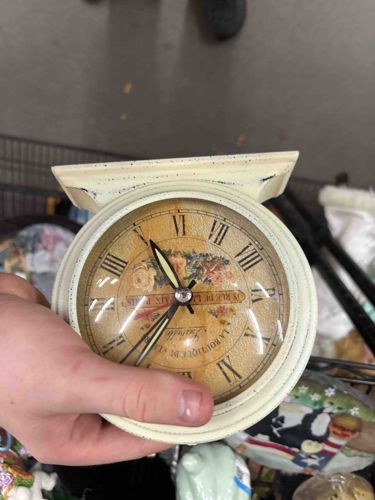
This item is a vintage-style decorative countertop clock, designed to resemble an antique kitchen scale. The main body of the clock is crafted from metal, finished in an distressed, off-white or cream color that mimics aged paint, complete with intentionally chipped areas, particularly noticeable on the upper platform edge, suggesting a 'shabby chic' aesthetic. The round clock face features Roman numerals for the hours, with the numbers III, VI, IX, and XII being distinctly visible. The background of the clock face is a sepia-toned or yellowish paper-like texture, adorned with floral motifs of roses and other muted greenery, giving it a romantic, old-world charm. French text is visible on the clock face, including phrases like "RUE DE LA" and "LA BOUTIQUE DE" along with what appears to be "PARIS," reinforcing its European vintage inspiration. The clock hands are black, with a decorative, somewhat ornate shape. A clear, domed plastic or glass cover protects the clock face, creating reflections that hint at its materiality. The clock is approximately the size of a human hand, as it is being held, indicating it's a relatively small, tabletop or shelf-sized piece. The overall condition appears good for its intended distressed style, with no obvious signs of unintentional damage beyond the manufactured aging. Its construction suggests it's primarily a decorative item, likely housing a quartz movement for functionality due to its size and typical modern manufacturing of such decorative clocks. The craftsmanship appears to be of standard quality for mass-produced decorative items, aiming for an aged aesthetic rather than precise historical replication, making it a good example of a decorative accent piece.
AI Appraisal Report
Based on my visual examination of the provided image, this Vintage-Style Decorative Countertop Clock is a mass-produced item designed to emulate an antique kitchen scale with a "shabby chic" aesthetic. The distressed finish, Roman numerals, floral motifs, and French text are all consistent with this decorative genre. The condition appears to be excellent for its intended style; the 'chipped' paint and aged appearance are manufactured features, not actual damage. There are no signs of unintentional wear or breakage.
Authenticity, in this context, refers to its claim as a 'vintage-style' piece rather than a genuinely antique one. From the image, it's clear this is a modern decorative reproduction. Its construction, the clarity of the printed face graphics, and the use of a likely quartz movement (inferred from typical modern manufacturing of such inexpensive items) reinforce this. Market conditions for such decorative clocks are robust, with a high supply of similar items from various retailers globally. Comparables include new decorative clocks found in department stores, home decor retailers, and online marketplaces. Demand is consistent for affordable decorative accents, but the item is neither rare nor unique, which significantly limits its secondary market value.
Factors impacting value primarily include its status as a decorative reproduction and its mass-produced nature. These items are valued for their aesthetic appeal as accent pieces rather than intrinsic antique value or horological significance. A physical examination would be needed to confirm the clock movement type (likely quartz), the material composition with certainty, and the true quality of construction beyond superficial appearance. Provenance documentation is not applicable here as it's a new decorative item. Without physical inspection, I cannot confirm the exact materials (e.g., if the 'metal' is tin, iron, or another alloy) or the precise movement, but these details would not significantly alter the appraisal value for this type of decorative item.