These notes were written by the person who submitted this item. Appraiser.AI has not verified them, and the AI's identification and estimate may rely on them.
AI Estimated Value
Not an official valuation
$60 - $100
AI estimate as of October 25, 2025 · verify with a professional before acting
AI-Generated · Verify before acting
Everything on this page is generated by AI for informational purposes only. AI can make mistakes — the AI may misidentify items or misattribute them (artist, maker, brand, designer, origin, era). This is not an official valuation and should not be used for insurance, sale, tax, estate, legal, or lending purposes — or any decision requiring a certified appraisal. It is not an authoritative claim about any person, brand, or rights holder — do not share or rely on it as a factual statement about a third party. Always consult qualified professionals before making financial decisions.
This analysis also relies on unverified notes provided by the user, which may be incomplete or inaccurate and could affect the result.
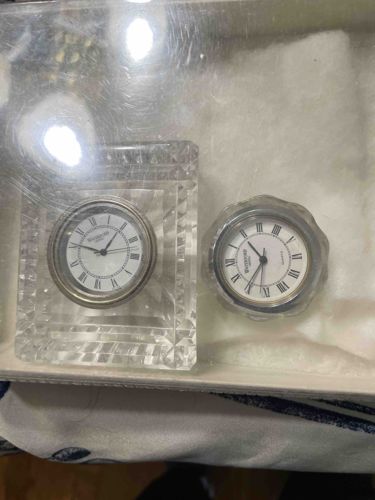
This item consists of a pair of desktop clocks, attributed to Waterford, both housed within their original or protective packaging, which appears to be a clear plastic lid over a padded box. The larger clock features a clear, geometric cut crystal body, shaped like a rectangular block, providing a stable base for the clock face. The crystal exhibits intricate facet cuts, indicative of traditional crystal craftsmanship, designed to refract light. The clock face itself is white with black Roman numerals and black hour, minute, and second hands, encased in a silver-toned bezel. The brand name 'Waterford' is visibly printed below the 12 o'clock position on the dial. The smaller clock, positioned to the right, also features a clear crystal body, but its shape is more organic and rounded, possibly resembling a flower or sunburst pattern around the clock face, again with decorative cuts. Its clock face is similar to the larger one: white, Roman numerals in black, black hands, and a silver-toned bezel. The 'Waterford' brand name is also visible on its dial, along with 'QUARTZ' which indicates a battery-powered movement. The packaging shows some superficial scratches and scuffs on the clear plastic lid, suggesting it has been handled or stored for some time. There are no immediate visible chips or cracks in the crystal components of the clocks themselves, although a thorough inspection outside the packaging would be required to confirm. The context indicates a need for batteries, implying both clocks are currently not operational. The overall style suggests a classic and elegant design, characteristic of Waterford crystal products, likely from the late 20th or early 21st century. The craftsmanship appears to be of high quality, with precise cuts in the crystal and clear, legible clock dials.
AI Appraisal Report
Upon examining the images provided, I have assessed a pair of Waterford Crystal desktop clocks. The set includes one larger rectangular clock and one smaller, more organically shaped clock. Both items appear to be in good to very good cosmetic condition, housed in what looks to be their original packaging. The crystal on both pieces exhibits the characteristic deep, precise cuts associated with the Waterford brand. The dials are clearly marked 'Waterford' and 'QUARTZ', which aligns with known products from the manufacturer. Based on these visual cues, I believe these items to be authentic Waterford pieces, likely from the late 20th or early 21st century.
The primary factor affecting the value is the current market for contemporary Waterford giftware. While the brand is prestigious, the secondary market is saturated with similar desktop clocks, which were produced in large quantities. Comparable sales for individual Waterford clocks of this type typically range from $30 to $60. As a pair, they are slightly more attractive to buyers. The fact that they require new batteries is a minor issue and does not significantly detract from the value, but their non-operational status at the time of appraisal is noted. The packaging shows some wear but has protected the clocks well, preserving their condition, which is a positive value factor.
My appraisal is limited as it is based solely on images. Full authentication would require in-person inspection to verify the Waterford acid-etched mark on the crystal and to assess for any minute chips or scratches not visible in the photos. Without physical examination, the possibility of high-quality replicas, though unlikely in this case, cannot be entirely dismissed.