AI estimate as of September 1, 2025 · verify with a professional before acting
AI-Generated · Verify before acting
Everything on this page is generated by AI for informational purposes only. AI can make mistakes — the AI may misidentify items or misattribute them (artist, maker, brand, designer, origin, era). This is not an official valuation and should not be used for insurance, sale, tax, estate, legal, or lending purposes — or any decision requiring a certified appraisal. It is not an authoritative claim about any person, brand, or rights holder — do not share or rely on it as a factual statement about a third party. Always consult qualified professionals before making financial decisions.
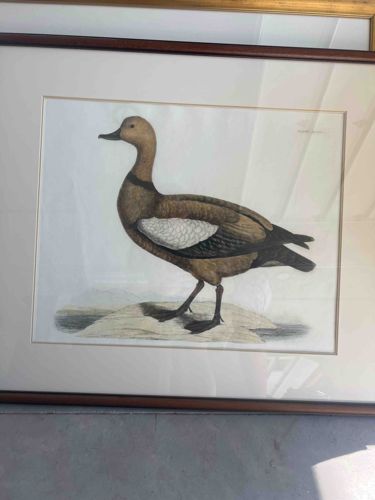
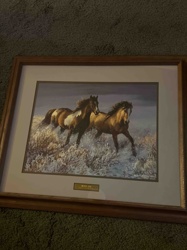
This item is a framed art print depicting a detailed illustration of a duck. The print itself appears to be a natural history illustration, characteristic of a scientific drawing or ornithological study. The duck is rendered in profile, facing left, with realistic brown and black plumage. A distinct feature is the white, scalloped pattern visible on its flank, indicating a specific species or feather texture. The duck is standing on what appears to be a light-colored, rocky or undulating ground plane, against a plain, light background that gives no contextual setting beyond the immediate ground. The colors used are predominantly earthy tones of brown, black, and subtle greys, with a hint of dark green or blue in the eye area. The illustration style suggests a vintage or antique origin, possibly from the 19th or early 20th century, consistent with hand-colored engravings or lithographs often found in historical natural history folios. No specific artist signature or publication markings are clearly visible in the image. The print is housed within a simple, dark brown wooden frame, possibly mahogany or a similarly stained wood, with a white or off-white matting that provides a pleasing border around the artwork. The frame shows minor signs of wear or dust collection, particularly along the bottom edge, but appears structurally sound. The overall presentation indicates a well-preserved piece, displayed under glass which exhibits some reflection from ambient lighting. The craftsmanship of the print itself, with its fine lines and detailed rendering of feathers, suggests a high level of artistic and scientific precision.
AI Appraisal Report
Based on my visual examination of the provided image, this framed ornithological print of a duck appears to be a vintage or antique natural history illustration. The detailing of the plumage, particularly the white scalloped pattern, suggests a specific depiction, likely from a folio or scientific publication. The print's condition within the frame seems good, with minor wear to the frame itself and some dust visible, but the print itself appears well-preserved under glass. The white matting enhances the presentation.
Authenticity, based solely on this image, cannot be definitively confirmed as an original hand-colored engraving or lithograph versus a later reproduction. The visible fine lines suggest a printmaking technique, but the absence of clear artist signatures, publication marks, or paper characteristics makes a firm determination impossible without in-person inspection. Similarly, the age estimation (19th or early 20th century) is based on stylistic cues. Without examining the paper, print method (e.g., halftone dots for photomechanical, plate marks for engravings), or provenance documentation, I cannot confirm it's not a modern giclée or offset print.
Market conditions for vintage natural history prints generally remain steady, with higher values for rare species, known artists (e.g., Audubon, Gould), or exceptionally rare publications. This print's appeal lies in its decorative quality and detailed depiction. Comparables would include other unframed and framed antique bird prints, where a framed, unidentified print typically falls into this range. Demand for decorative vintage natural history art is consistent, but rarity for this specific untitled piece is difficult to assess without further information. Factors impacting value are primarily the actual print method (original vs. reproduction), and definitive identification of the artist and publication. A physical examination to assess paper type, print impression, and potential hidden markings, along with provenance documentation, would be crucial for complete authentication and a more precise valuation.