AI estimate as of December 11, 2025 · verify with a professional before acting
AI-Generated · Verify before acting
Everything on this page is generated by AI for informational purposes only. AI can make mistakes — the AI may misidentify items or misattribute them (artist, maker, brand, designer, origin, era). This is not an official valuation and should not be used for insurance, sale, tax, estate, legal, or lending purposes — or any decision requiring a certified appraisal. It is not an authoritative claim about any person, brand, or rights holder — do not share or rely on it as a factual statement about a third party. Always consult qualified professionals before making financial decisions.
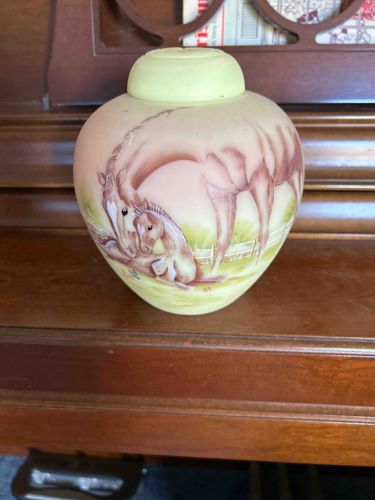
This appears to be a vintage satin glass ginger jar, featuring a soft, pearlescent finish over a primary color scheme of light yellow-green, transitioning to a pale, blush pink or peach in the central area. The jar has a squat, rounded body that tapers slightly towards the neck, which is topped with a removable lid of the same light yellow-green color and satin finish. The most prominent feature is the hand-painted or transfer-applied decoration depicting an adult horse nuzzling a young foal. The horses are rendered in shades of brown and reddish-brown, with delicate outlines and some shading, suggesting a tenderness in the scene. They are depicted against a light green grassy background with a subtle white fence detail. The overall artwork style is somewhat illustrative and romanticized. The satin finish suggests it might be from the late 19th or early 20th century, a popular period for such glasswork, or a later reproduction aiming for that aesthetic. The condition appears good, with no obvious chips, cracks, or significant paint loss visible from the provided image. The frosted or satin look of the glass diffuses light, giving it a soft glow. There are no visible maker's marks or signatures in the provided views, which would require inspection of the base. The craftsmanship seems solid for a decorative art glass piece of this type.
AI Appraisal Report
Upon visual examination of the provided image, I have assessed this satin glass ginger jar with horse and foal decoration. The condition appears to be good; I observe no obvious chips, cracks, or significant paint loss on the decorative motif or the glass surface, which is a positive factor. The satin finish is consistent with pieces from the late 19th to early 20th century, or later decorative reproductions emulating that style. The hand-painted or transfer decoration is charming, depicting a tender scene that would appeal to collectors of animal-themed decor.
Regarding authenticity, without a physical inspection, especially of the base for maker's marks, it is challenging to definitively attribute this piece to a specific manufacturer or period. Many companies, both American and European, produced decorative satin glass wares. The lack of a visible mark from the image limits the ability to assign it to a notable glasshouse, which would significantly impact its value. Currently, the market for decorative satin glass, particularly unmarked pieces like this, is stable but not experiencing significant surges in demand. Comparable items, typically decorative rather than fine art glass, tend to fall within a modest range, especially when the maker is unknown. Demand is driven more by aesthetic appeal and condition rather than rarity, as similar items were produced in considerable quantities.
Factors impacting value include the charming decoration, good condition, and the overall decorative appeal. However, the absence of an identifiable maker's mark and the relatively common nature of such decorative glass without premium attribution limit the upper potential. For full authentication and a more precise valuation, a physical examination would be crucial to look for mold lines, pontil marks, maker's signatures, and to assess the quality of the glass and decoration in person. Provenance documentation, if available, would also be invaluable. Based on what is visible, I would place its current market value in the decorative arts category.