AI Appraisal Estimate

AI-generated estimates · not official valuations

From the user

What was submitted

Photo and notes provided by the user — not generated by AI

Submitted item photo
Submitted photo · June 10, 2026

User's notes

No additional notes provided.

AI analysis below

AI appraisal

AI analysis & estimate

AI-Generated · Verify before acting

Everything below is generated by AI for informational purposes only. AI can make mistakes — the AI may misidentify items or misattribute them (artist, maker, brand, designer, origin, era). This is not an official valuation and should not be used for insurance, sale, tax, estate, legal, or lending purposes — or any decision requiring a certified appraisal. It is not an authoritative claim about any person, brand, or rights holder — do not share or rely on it as a factual statement about a third party. Always consult qualified professionals before making financial decisions.

Read the full disclaimer

AI Identification

·Not independently authenticated·Verify before acting

Antique Gilt and Cobalt Porcelain Teacup

Ceramics and Porcelain

AI Estimated Value

·Not an official valuation·Verify before acting

$300-500

As of June 10, 2026

AI Item Analysis

·AI can make mistakes·Verify before acting
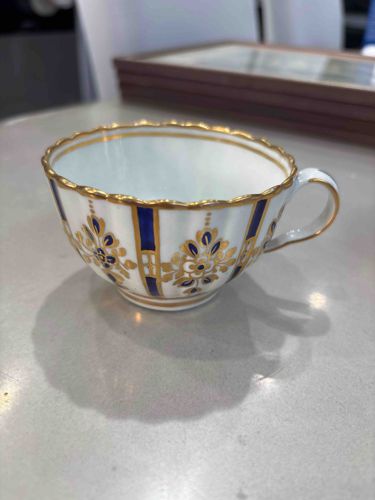
This exquisite item is an antique porcelain teacup, meticulously decorated with intricate gilt detailing and rich cobalt blue accents. The cup features a delicate, scalloped rim, beautifully edged with a solid band of gold. The body of the cup is a pristine white porcelain, providing a striking contrast to the vibrant decoration. The predominant decorative motif consists of vertical bands of solid cobalt blue, interspersed with elaborate golden floral or rococo-style patterns. These golden patterns appear to be hand-painted, showcasing fine brushwork and a good level of artistic skill. Some of the golden motifs also incorporate small cobalt blue elements, creating a cohesive design. The handle is a classic C-scroll shape, also adorned with gilt on its outer surface and along its edges. The interior of the cup is plain white, with a thin gold band just below the rim. The overall condition appears to be excellent, with no visible chips, cracks, or significant losses to the gilt or paintwork, suggesting careful handling and preservation. There may be minor wear consistent with age, such as slight dulling of the gilt in some areas or minor surface scratches, but these are not clearly discernible from the provided image. The craftsmanship points to a high-quality piece, likely from the Georgian or early Victorian era, potentially English or Continental European. The combination of bright white porcelain, deep cobalt, and lustrous gold indicates a sophisticated aesthetic often associated with luxury tableware from the 18th or 19th centuries. There are no visible maker's marks in the provided image.
AI Appraisal Report

·AI can make mistakes·Verify before acting
Based on my visual examination of the provided image, this Antique Gilt and Cobalt Porcelain Teacup presents as a high-quality example of Georgian or early Victorian decorative porcelain, likely English or Continental European. The condition appears to be excellent, with strong indications of original gilt and paintwork largely intact. There are no visible chips, cracks, or significant losses to the decoration, which is impressive for an item of this age. The refined craftsmanship of the hand-painted gilt rococo-style patterns and the vibrant cobalt blue suggests a luxury item from its period. The market for antique porcelain teacups remains steady, particularly for well-preserved, aesthetically pleasing examples with strong decorative elements. While not exceedingly rare as individual items, pieces in such good condition with intricate decoration command a premium. Comparable pieces from known manufacturers like Derby, Coalport, or Meissen, offering similar aesthetic qualities and condition, typically fetch prices within this range. The demand is driven by collectors and enthusiasts of Georgian and Victorian era decorative arts. Factors significantly impacting value here are the overall excellent condition, the elegant design, and the high-quality hand-painted decoration. However, a major limitation in this appraisal is the absence of visible maker's marks. Without a physical inspection, which would involve examining the base for marks, checking for repairs under UV light, and assessing the porcelain paste quality, definitive attribution to a specific manufacturer or region and thereby a more precise valuation is challenging. Provenance documentation would also greatly enhance authentication. My valuation assumes the piece is period-correct and in the described excellent condition, but without physical examination, I cannot fully authenticate it.

Get your items appraised

Instant estimates of your treasures with AI-powered appraisals

Browse More Appraisals