AI estimate as of September 27, 2025 · verify with a professional before acting
AI-Generated · Verify before acting
Everything on this page is generated by AI for informational purposes only. AI can make mistakes — the AI may misidentify items or misattribute them (artist, maker, brand, designer, origin, era). This is not an official valuation and should not be used for insurance, sale, tax, estate, legal, or lending purposes — or any decision requiring a certified appraisal. It is not an authoritative claim about any person, brand, or rights holder — do not share or rely on it as a factual statement about a third party. Always consult qualified professionals before making financial decisions.
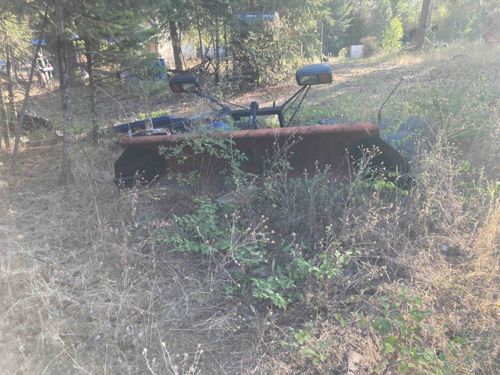
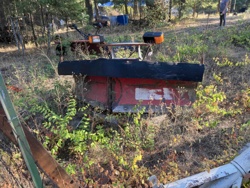
This item appears to be a vintage or older model walk-behind tractor, possibly with an attached implements such as a moldboard plow or a cultivating blade, given the broad, dark, rusty metal front-facing section. The primary color visible on the main body of the tractor appears to be a faded blue or dark color, although much of it is obscured by rust and the surrounding vegetation. The handle grips, typically black, are visible and appear to be made of rubber or a similar polymer, showing some wear but retaining their general shape. The metal frame supporting the handles is black. The item is located outdoors, partially submerged in overgrown brush and dry grass, suggesting it has been stored or abandoned in this position for a significant period. Extensive surface rust is clearly visible on the large front attachment, indicating prolonged exposure to the elements. Some structural components of the tractor's frame are visible beneath the attachment, also showing signs of rust and weathering. The overall condition suggests that it is not currently operational without significant restoration. No specific manufacturer's marks or model numbers are discernible from the image. Given its apparent age and design, it likely dates from the mid to late 20th century. The quality of craftsmanship, while difficult to ascertain in its current state, would have been robust for agricultural or landscaping tasks of its era, typically featuring heavy-gauge steel construction for durability. The unique aspect here is its state of disuse and overgrowth, which indicates a substantial need for cleaning, repair, and potential parts replacement.
AI Appraisal Report
Based on my visual examination of the provided image, this walk-behind tractor appears to be a vintage model from the mid to late 20th century, equipped with a large front attachment, likely a moldboard plow or cultivating blade. The primary color, though faded to blue/dark, is largely obscured by extensive rust and overgrowth. The handle grips show wear but are intact. Its location outdoors, partially submerged in brush, strongly suggests a long period of disuse and abandonment. The overwhelming presence of surface rust on the attachment and visible frame components indicates severe weathering. This item is unequivocally in non-operational condition and would require significant restoration efforts, including cleaning, rust removal, engine overhaul (if present), and likely replacement of numerous parts such as fuel lines, carburetor components, and potentially tires (though not visible). Without specific manufacturer marks or model numbers, authenticity from a collector's standpoint is limited.
In terms of market conditions, vintage non-running equipment, especially without known provenance or a desirable make/model, typically has a very low intrinsic value. Demand would be limited to hobbyists looking for project pieces or individuals interested in salvaging parts. Its rarity is undetermined, but given the generic appearance, it's unlikely to be a highly sought-after collectible. The most significant factors impacting its value are its extremely poor, non-functional condition and the lack of specific identifying marks.
Limitations in authenticity verification are substantial from images alone. A full authentication would require in-person examination to ascertain the manufacturer, model, engine condition, and assess the extent of structural integrity issues. Documentation of its history (provenance) would also be crucial for any potential collectible value. Without these, its value is primarily as scrap metal or a very challenging restoration project. I estimate a value in the range of $25-$100, reflecting its scrap value or minimal worth as a severely compromised project piece.