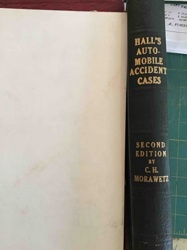
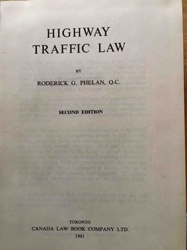
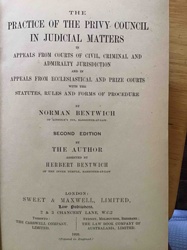
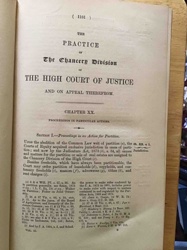
These notes were written by the person who submitted this item. Appraiser.AI has not verified them, and the AI's identification and estimate may rely on them.
AI Estimated Value
Not an official valuation
$40-70
AI estimate as of July 27, 2025 · verify with a professional before acting
AI-Generated · Verify before acting
Everything on this page is generated by AI for informational purposes only. AI can make mistakes — the AI may misidentify items or misattribute them (artist, maker, brand, designer, origin, era). This is not an official valuation and should not be used for insurance, sale, tax, estate, legal, or lending purposes — or any decision requiring a certified appraisal. It is not an authoritative claim about any person, brand, or rights holder — do not share or rely on it as a factual statement about a third party. Always consult qualified professionals before making financial decisions.
This analysis also relies on unverified notes provided by the user, which may be incomplete or inaccurate and could affect the result.
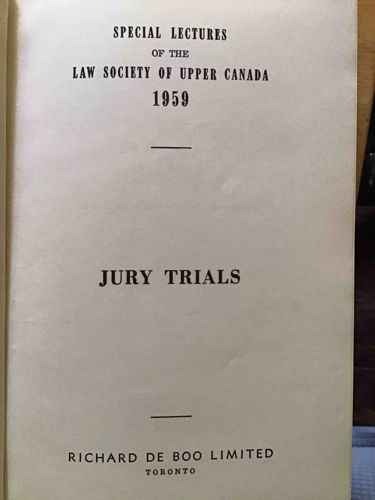
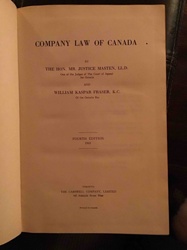
This item is a legal publication, specifically a book titled "JURY TRIALS." It is presented as a volume of 'Special Lectures of The Law Society of Upper Canada' from the year 1959. The visible page, likely the title page or an interior frontispiece, is made of a light-colored, possibly off-white or cream, paper. The text is printed in black ink using a clear, serif typeface, maintaining excellent legibility. The layout is clean and centered, featuring bold headings for 'SPECIAL LECTURES', 'JURY TRIALS', and the publisher's information. The year '1959' is prominently displayed. Two horizontal lines act as separators above and below 'JURY TRIALS', contributing to the balanced design. The publisher is identified as 'RICHARD DE BOO LIMITED' located in 'TORONTO'.
The overall condition appears to be good, as indicated by the context. There are no immediate visible signs of major wear, tears, stains, or foxing on the visible page. The paper shows a slight, uniform discoloration consistent with age, but this contributes to its patina rather than detracting from its condition. The binding is not visible, but the flatness of the page suggests it has been well-preserved. There are no handwritten annotations, unique markings, or signs of repair on this specific page. As a legal text from 1959 published by a Canadian entity, it represents a mid-20th-century legal resource, likely targeting legal professionals, scholars, or students of law.
AI Appraisal Report
Upon my virtual examination of the provided image of 'Special Lectures of The Law Society of Upper Canada 1959: Jury Trials,' I assess this item to be in good condition. The visible page exhibits excellent legibility with clear, black print on what appears to be a light-colored paper, showing only a slight, uniform discoloration consistent with age, contributing to its patina rather than detracting from its overall appearance. There are no visible tears, stains, foxing, or major wear, and no handwritten annotations or signs of repair. While the binding is not visible, the flatness of the page suggests it has been well-preserved.
This specific volume, 'Jury Trials' from 1959, is a mid-20th-century legal publication. Legal texts of this period from the Law Society of Upper Canada are generally not rare given their original purpose as resources for legal professionals, scholars, and students. The demand for such publications is typically niche, primarily among legal historians, libraries specializing in legal archives, and collectors of Canadian legal history. Comparables would include other volumes from this 'Special Lectures' series or similar Canadian legal publications from the mid-20th century. While historically significant, the material's specific content on 'Jury Trials' from 1959, while still relevant in principle, is superseded by contemporary legal developments for practical legal application.
Factors significantly impacting its value include its good condition, which is a positive, but offset by its general availability within the realm of historical legal texts. The lack of particular provenance or unique features limits its appeal beyond a standard collectible. For full authentication and a definitive assessment of condition, an in-person examination would be crucial. This would allow for a thorough inspection of the binding, all pages for wear, foxing, or repairs not visible in the single image, and to verify paper integrity and printing quality. Provenance documentation, if available, could confirm its history and potentially enhance value, though it is less critical for a standard legal publication unless tied to a significant figure.