These notes were written by the person who submitted this item. Appraiser.AI has not verified them, and the AI's identification and estimate may rely on them.
AI Estimated Value
Not an official valuation
$75-125
AI estimate as of July 27, 2025 · verify with a professional before acting
AI-Generated · Verify before acting
Everything on this page is generated by AI for informational purposes only. AI can make mistakes — the AI may misidentify items or misattribute them (artist, maker, brand, designer, origin, era). This is not an official valuation and should not be used for insurance, sale, tax, estate, legal, or lending purposes — or any decision requiring a certified appraisal. It is not an authoritative claim about any person, brand, or rights holder — do not share or rely on it as a factual statement about a third party. Always consult qualified professionals before making financial decisions.
This analysis also relies on unverified notes provided by the user, which may be incomplete or inaccurate and could affect the result.
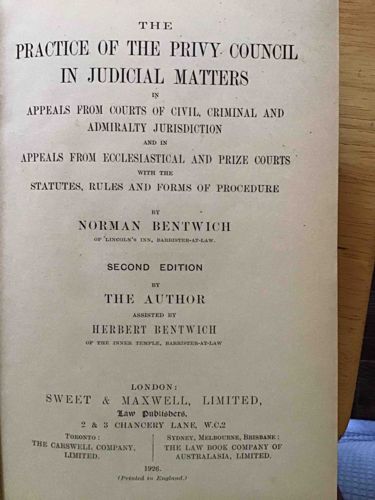
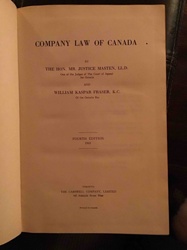
This item is the title page of a legal treatise titled 'The Practice of the Privy Council in Judicial Matters'. The book is a second edition, authored by Norman Bentwich, 'of Lincoln's Inn, Barrister-at-Law', and assisted by Herbert Bentwich, 'of the Inner Temple, Barrister-at-Law'. The publication details indicate it was released in 1926 by Sweet & Maxwell, Limited, Law Publishers, located at 2 & 3 Chancery Lane, W.C.2, London. Further distribution is noted in Toronto by The Carswell Company, Limited, and in Sydney, Melbourne, and Brisbane by The Law Book Company of Australasia, Limited. The title page specifies the book covers appeals from courts of civil, criminal, and admiralty jurisdiction, as well as appeals from ecclesiastical and prize courts, including statutes, rules, and forms of procedure. The page itself is made of what appears to be off-white or cream-colored paper, showing a slight discoloration consistent with age, though reported to be in 'good condition'. There are minor visible specks or foxing on the paper, indicative of typical aging for a paper product of this era. The text is printed in black ink, featuring various font sizes and styles to differentiate headings, authors, and publisher information, characteristic of professional typesetting from the early 20th century. No significant tears, creases, or major damage are apparent from the visible portion, suggesting the good condition is likely for the entire book. The visible texture of the paper also suggests a standard book paper of the period, possibly with a slightly fibrous quality. The overall presentation is professional and functional, as expected for a legal reference work.
AI Appraisal Report
Based on my examination of the provided image and the owner's details, this second edition of 'The Practice of the Privy Council in Judicial Matters' by Bentwich, published in 1926, appears to be in good condition. The title page exhibits typical aging for early 20th-century paper, including slight discoloration and minor foxing, but no apparent tears, creases, or major damage, which aligns with the 'good condition' report. The typesetting and publication details are consistent with historical legal texts from Sweet & Maxwell. Authenticity, based solely on this image, seems solid as it matches known publication details for this work.
In terms of market conditions, legal treatises from this period generally have a niche but consistent demand, primarily from legal historians, academic libraries, and some private collectors interested in British legal history or the history of the Privy Council. While not exceedingly rare, a second edition in good condition can be more desirable than later, less historically significant printings. Comparables for similar legal texts of this vintage in good condition typically range from $50 to $150. Factors impacting value include the book's specific historical relevance within legal studies, its complete condition, and any association with notable figures (though none indicated here).
The primary limitation in this appraisal is the reliance on a single image of the title page. A full in-person examination would be crucial to assess the condition of the entire volume, including the binding, all internal pages (for foxing, highlighting, or marginalia), and completeness. Provenance documentation could potentially enhance value, though it's less critical for standard legal texts than for rare books or manuscripts. No scientific testing is typically required for books of this era unless there are concerns about paper or ink authenticity, which are not apparent here.