AI estimate as of July 14, 2025 · verify with a professional before acting
AI-Generated · Verify before acting
Everything on this page is generated by AI for informational purposes only. AI can make mistakes — the AI may misidentify items or misattribute them (artist, maker, brand, designer, origin, era). This is not an official valuation and should not be used for insurance, sale, tax, estate, legal, or lending purposes — or any decision requiring a certified appraisal. It is not an authoritative claim about any person, brand, or rights holder — do not share or rely on it as a factual statement about a third party. Always consult qualified professionals before making financial decisions.
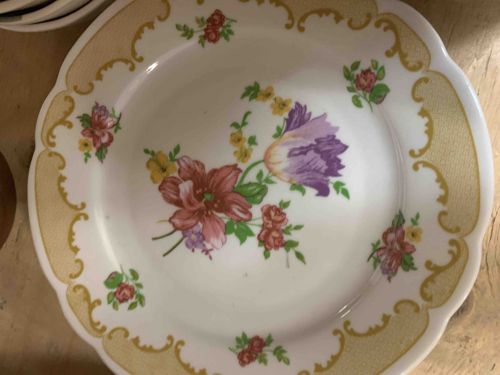
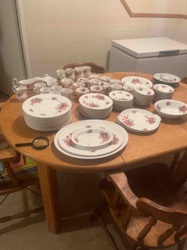
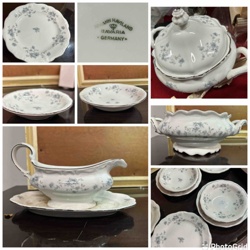
This item is a decorative ceramic dinner plate featuring a floral pattern. The plate has a scalloped edge, adding a touch of elegance and a classic aesthetic. The primary color of the plate is off-white or cream, serving as a bright canvas for the colorful design. A notable feature is the wide border around the rim, which is rendered in a textured, light golden-yellow or beige color with an ornate scroll pattern in a slightly darker golden hue. The central design consists of a vibrant bouquet of flowers. Prominent flowers include a large, detailed reddish-pink bloom, possibly a lily or similar garden flower, and a distinctive purple and yellow tulip. Smaller floral clusters in shades of red, pink, and yellow are scattered across the plate, complemented by green foliage. The colors of the floral motifs appear to be applied as decals rather than hand-painted, suggesting mass production. There are no clear visible condition issues such as chips, cracks, or significant wear on the decorative elements, indicating it is either well-preserved or has seen minimal use. The glaze appears intact and glossy. The style suggests a mid-20th century to late 20th-century aesthetic, common in dinnerware sets from that period. There are no visible maker's marks or signatures on the face of the plate, and the reverse is not visible in the image. The craftsmanship appears to be of standard quality for household dinnerware, designed for everyday use or casual entertaining.
AI Appraisal Report
Upon visual examination of the provided images, I have assessed this floral pattern scalloped ceramic dinner plate. The plate appears to be in excellent condition, with no visible chips, cracks, or crazing. The glaze is glossy, and the colorful decal decorations are vibrant and intact, suggesting it has been well-preserved or used sparingly. The design, featuring a scalloped edge, a golden scroll border, and a central floral bouquet, is characteristic of mid-to-late 20th-century mass-produced dinnerware. The use of decals, rather than hand-painting, points towards factory production rather than an artist's studio piece.
The market for individual dinner plates of this type is generally modest. Without a visible maker's mark on the reverse, it is difficult to attribute it to a specific, collectible manufacturer like Lenox, Royal Doulton, or Villeroy & Boch, which significantly limits its value. It is most likely part of a larger dinnerware set, and as a single piece, its value is primarily decorative. Comparable individual plates from unknown or less-distinguished makers from this era typically sell for low prices in secondary markets like online marketplaces and thrift stores. Demand is limited to individuals seeking to replace a broken piece from their own set or those who appreciate the aesthetic for decorative purposes.
It is crucial to note the limitations of this appraisal. Without a physical inspection, I cannot confirm the absence of hairline cracks or repairs, nor can I examine the reverse for a manufacturer's mark, which is a key determinant of value. A definitive appraisal would require in-person examination to verify the maker, country of origin, and assess the true condition.