AI estimate as of October 31, 2025 · verify with a professional before acting
AI-Generated · Verify before acting
Everything on this page is generated by AI for informational purposes only. AI can make mistakes — the AI may misidentify items or misattribute them (artist, maker, brand, designer, origin, era). This is not an official valuation and should not be used for insurance, sale, tax, estate, legal, or lending purposes — or any decision requiring a certified appraisal. It is not an authoritative claim about any person, brand, or rights holder — do not share or rely on it as a factual statement about a third party. Always consult qualified professionals before making financial decisions.
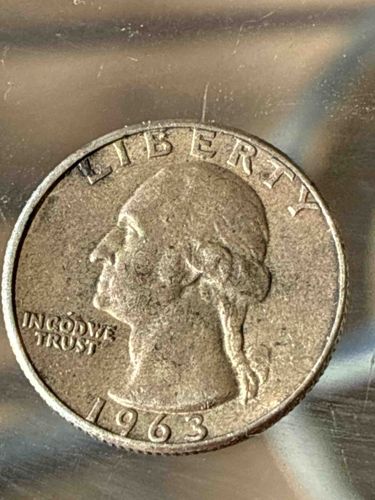
This item is a 1963 Washington Quarter, specifically the silver composition variety. The obverse depicts the left-facing bust of George Washington, designed by John Flanagan. Above his head, the word 'LIBERTY' is clearly visible, though somewhat worn. To his left, beneath his chin, the motto 'IN GOD WE TRUST' is inscribed, with noticeable wear affecting the clarity of some letters. Below Washington's bust, the minting year '1963' is sharply legible. The coin exhibits a metallic silver-grey color with a muted, somewhat dull luster, indicative of its age and circulation. There are discernible signs of wear across the high points of the design, particularly on Washington's hair, cheek, and the lettering surrounding the portrait. The rim appears intact but shows some minor nicks and flattening in areas. The reeded edge is visible, suggesting it's still relatively well-preserved, though some individual reeds might be slightly flattened from circulation. No specific mint mark is visible on this side, which for a 1963 silver quarter suggests it was minted in Philadelphia ('P' mint mark was not used on quarters until 1980, and the absence of 'D' or 'S' confirms Philadelphia). The overall condition is good for a circulated coin of its age, though it does not appear to be uncirculated. There are no obvious signs of significant damage like bends, deep scratches, or repairs, but surface abrasions and light scratches consistent with typical handling are present. This quarter represents the final year of 90% silver coinage for the Washington Quarter series before the transition to copper-nickel clad composition in 1965.
AI Appraisal Report
Based on my visual examination of the provided image, this 1963 Washington Quarter (Type 1: Silver) appears authentic. The key design elements, including Washington's bust, the 'LIBERTY' and 'IN GOD WE TRUST' mottos, and the '1963' date, are consistent with known examples of this mintage. The absence of a mint mark confirms it as a Philadelphia strike, which is correct for a 1963 quarter without an 'S' or 'D'. Its metallic silver-grey color and muted luster are typical of a 90% silver coin that has been in circulation.
The condition, as described, suggests Good to Very Good (G-VG) circulated condition. I observe noticeable wear on high points like Washington’s hair and cheek, and on the lettering, particularly 'IN GOD WE TRUST,' which aligns with significant circulation. The intact but slightly nicked rim and visible reeded edge, despite some flattening, support this assessment. There are no indications of significant damage, cleaning, or alteration. For a definitive assessment of condition, including precise grading and identification of subtle surface issues like hairlines or environmental damage, a physical in-hand inspection is crucial.
From a market perspective, 1963 Washington Quarters are common in circulated grades. Their primary value is closely tied to their silver content. Current market prices for 90% silver quarters dictate a base melt value, with a small premium for circulated examples like this. Demand is steady from bullion investors and entry-level collectors, but rarity is low. Uncirculated examples command higher premiums, but this coin clearly falls into the circulated category.
Key factors impacting value here are the silver content and the coin's circulated but undamaged state. Without physical inspection, I cannot confirm the absolute absence of micro-scratches, environmental damage, or potential subtle cleaning which could impact value negatively. A full authentication would require in-person examination to verify weight, diameter, thickness, and precise alloy composition, though the visual cues are strong enough for a preliminary assessment of authenticity. Provenance documentation would add to its historical context but is not typically critical for common circulated coinage like this.