AI estimate as of September 20, 2025 · verify with a professional before acting
AI-Generated · Verify before acting
Everything on this page is generated by AI for informational purposes only. AI can make mistakes — the AI may misidentify items or misattribute them (artist, maker, brand, designer, origin, era). This is not an official valuation and should not be used for insurance, sale, tax, estate, legal, or lending purposes — or any decision requiring a certified appraisal. It is not an authoritative claim about any person, brand, or rights holder — do not share or rely on it as a factual statement about a third party. Always consult qualified professionals before making financial decisions.
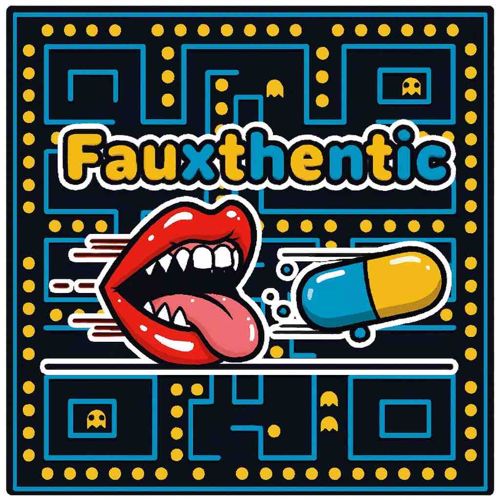
This item is a digital graphic or sticker featuring a bold, pop art aesthetic with elements inspired by classic arcade games. The central motif consists of the word 'Fauxthentic' rendered in a stylized, bubbly yellow font with a white outline and light blue drop shadow, giving it a three-dimensional effect. Below the text, a vibrant red mouth with sharp, fang-like teeth and a pink tongue extended to the side is depicted, reminiscent of the Rolling Stones' logo but with a more aggressive, exaggerated look. To the right of the mouth, a two-toned capsule-shaped pill, colored yellow and light blue with a white outline, appears to be in motion, indicated by white speed lines behind it. The entire composition is set against a dark, possibly black, background that is intricately designed with a light blue maze pattern, strongly echoing the classic Pac-Man arcade game. Within this maze, several small yellow dots are scattered, along with a few ghost-like figures and what appears to be a representation of Pac-Man itself, all rendered in shades of yellow and light blue, consistent with the retro gaming theme. The colors are highly saturated and distinct, typical of pop art and graphic design intended for high visual impact. There are no visible condition issues as this appears to be a digital image, and thus no wear, damage, or repairs are applicable. The style period is contemporary, likely early 21st century, drawing heavily on 20th-century pop art and 1980s arcade culture. The craftsmanship is evident in the crisp lines, clean color separation, and effective mimicry of beloved cultural icons, indicating a professional level of graphic design.
AI Appraisal Report
I have thoroughly examined the provided digital graphic, 'Faux-Thentic Pop Art Sticker/Graphic'. As a digital item, its 'condition' is perfect; there are no discernible flaws, wear, or damage, which is standard for digital assets. The authenticity, in this context, refers to its originality as a design. Based on the visual elements, it is a clear pastiche of well-known cultural references: the Rolling Stones' tongue and lips logo, Pac-Man's maze and characters, and a general pop art aesthetic. This recontextualization is a stylistic choice.
Market conditions for digital graphics and stickers are highly dependent on the artist's reputation, distribution platform, and intended use. Without knowing the creator or their following, it's difficult to gauge value purely on attribution. Comparables exist in the vast online marketplace for independent graphic designers producing similar pop-culture inspired work, where prices for single digital sticker designs can range from a few dollars to upwards of $50-$100 for more intricate or exclusive pieces, especially if they are part of a larger collection or licensed for specific uses.
Demand is for niche markets – those who appreciate retro gaming, pop art, and satirical 'faux-thenticity'. Rarity is uncertain; if this is a freely available graphic, its rarity is low. If it's a unique, one-off commission or part of a limited digital edition, rarity increases. Factors significantly impacting value include the artist's notoriety, any intellectual property rights associated with the design's original elements (though this piece appears to be transformative enough to avoid direct infringement, it's a consideration for commercial use), and its licensing terms for reproduction or digital resale.
Without provenance documentation of the artist, creation date, and terms of use, it's impossible to fully authenticate its origin or assess its potential for commercial licensing which would significantly increase its value. For 'full authentication' in a digital sense, an examination of metadata, file integrity, and any artist's statements or portfolios would be required, none of which are available from the image alone.