AI estimate as of November 7, 2025 · verify with a professional before acting
AI-Generated · Verify before acting
Everything on this page is generated by AI for informational purposes only. AI can make mistakes — the AI may misidentify items or misattribute them (artist, maker, brand, designer, origin, era). This is not an official valuation and should not be used for insurance, sale, tax, estate, legal, or lending purposes — or any decision requiring a certified appraisal. It is not an authoritative claim about any person, brand, or rights holder — do not share or rely on it as a factual statement about a third party. Always consult qualified professionals before making financial decisions.
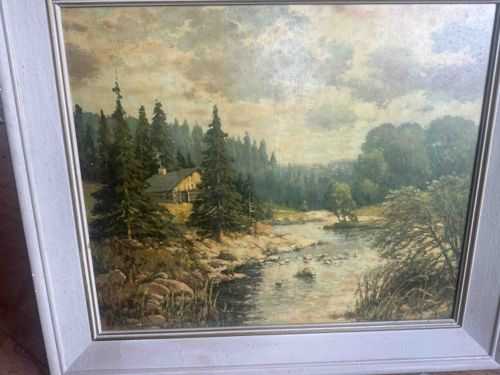
This appears to be an oil painting depicting a tranquil mountain landscape scene. The central focus is a rustic wooden cabin nestled among dense evergreen trees on the left side of a winding river or stream. The cabin features a dark roof and appears to be constructed from logs, suggesting a remote, natural setting. The river, with rocky banks and visible stones within its clear waters, flows from the background towards the foreground. On the right side, sparse trees with lighter foliage frame the river, contrasting with the darker, thicker pines on the left. The sky is overcast with a mix of light and dark clouds, suggesting either early morning, late afternoon, or inclement weather, contributing to a muted color palette dominated by greens, browns, and grays. The overall style suggests a realist or naturalistic approach, possibly from the late 19th or early 20th century, a common period for this type of landscape art. The painting is housed in a simple, light-colored wooden frame, possibly painted white or a very pale grey, which has a slightly textured or aged finish. There are visible signs of age to the painting itself, including general discoloration, potential cracking or craquelure of the paint surface, and some darkening (patina) across the canvas, particularly in the sky and lighter areas. The artist's signature, "M. Olssen," is faintly visible in the lower left corner. The craftsmanship appears to be of moderate quality, with adequate detail in the trees and water, though without highly refined brushwork, indicating it could be a production piece or by a lesser-known but trained artist. The frame itself shows some chips or wear along its edges, consistent with age and handling.
AI Appraisal Report
Based on my visual examination of the provided image, this oil painting by 'M. Olssen' depicts a tranquil mountain landscape with a cabin and river. The painting exhibits a naturalistic style, common in late 19th to early 20th-century landscape art. The muted palette of greens, browns, and grays, along with the atmospheric sky, suggests a traditional approach to the subject. The craftsmanship appears to be moderate, with adequate detail but not highly refined brushwork, indicating it may be the work of a trained but lesser-known artist, or possibly a production piece.
The condition of the painting shows signs of age, including general discoloration and potential craquelure, consistent with its likely vintage. There is also a noticeable darkening or patina, particularly in the sky, which can affect the overall vibrancy. The simple, light-colored wooden frame, also showing wear and chips, complements the artwork but does not add significant value beyond framing it. The signature 'M. Olssen' is visible, but without further research into this artist, their market presence and demand are presumed to be limited. This significantly impacts the value, as works by unestablished artists typically command lower prices.
Market conditions for unsigned or lesser-known landscape artists from this period are generally stable but not highly speculative. Comparable pieces by unknown or regional artists of similar quality typically fall within the sub-$500 range. Demand for such pieces is often driven by decorative appeal rather than art historical significance or investment potential.
Limitations in authenticity verification are significant based on images alone. A physical inspection would be crucial to confirm the medium, assess the true extent of condition issues like craquelure and discoloration, and examine the brushwork and paint layers directly. Provenance documentation or further research into a potential 'M. Olssen' would also be essential for full authentication and to potentially identify the artist, which could impact value.