AI estimate as of October 31, 2025 · verify with a professional before acting
AI-Generated · Verify before acting
Everything on this page is generated by AI for informational purposes only. AI can make mistakes — the AI may misidentify items or misattribute them (artist, maker, brand, designer, origin, era). This is not an official valuation and should not be used for insurance, sale, tax, estate, legal, or lending purposes — or any decision requiring a certified appraisal. It is not an authoritative claim about any person, brand, or rights holder — do not share or rely on it as a factual statement about a third party. Always consult qualified professionals before making financial decisions.
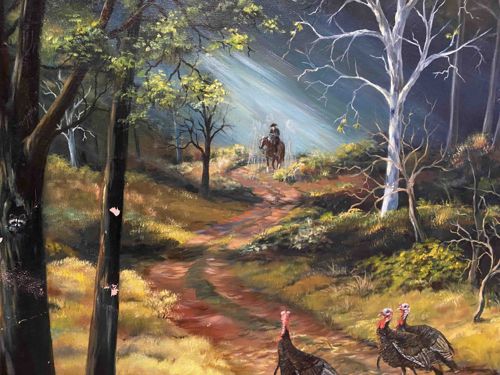
This is a vibrant oil or acrylic painting depicting a dense forest scene with multiple elements. The primary color palette consists of deep greens, earthy browns, and golden yellows for the foliage and ground, contrasted with striking blues and whites for rays of light and certain tree trunks. The construction appears to be a traditional painting on canvas or board. A winding, reddish-brown dirt path dominates the middle ground, leading the eye into the depth of the forest. In the upper middle section, a lone figure on horseback is visible, riding along the path, partially obscured by a bright shaft of light descending from the upper left. The light illuminates the horseman and a section of the path, creating a dramatic effect. To the right of the path, a prominent tree with white bark and bare, intricate branches stands out against the darker background, suggesting either a particular species or the influence of the light. In the foreground, two wild turkeys are prominently featured walking on the path to the right, exhibiting characteristic dark plumage and red heads. On the left side, embedded within the bark of a large, dark tree, a small, stylized image of a raccoon's face is subtly visible, adding a hidden detail. Other trees with rich, dark bark and varied foliage frame the scene. The brushwork appears somewhat loose and expressive, particularly in the trees and ground cover, giving the painting a lively, dynamic feel. There are no obvious signs of significant damage or repair, and the colors are still quite vivid. The overall style suggests a realist or impressionistic approach to a natural landscape, possibly from the late 20th or early 21st century given the apparent condition and style. The artist's signature or any specific manufacturing marks are not discernible from the provided image.
AI Appraisal Report
Based on my visual examination of the provided image, this oil or acrylic painting, 'Forest Scene with Horseman, Turkeys, and Raccoon,' appears to be in good condition. The colors are vivid, and there are no discernible signs of significant damage or repair. The artistic style leans towards a realist or impressionistic approach to landscape painting, suggesting a late 20th or early 21st-century origin. The hidden raccoon detail and the dramatic lighting add character.
Authenticity verification is limited by the image alone; I cannot definitively confirm if it is an original work, a print, or a copy without in-person inspection. I would need to examine the brushwork texture, canvas quality, and edges to confirm its originality. I also cannot identify an artist's signature from the provided image, which significantly impacts value.
Market conditions for unsigned contemporary landscapes like this generally place them in the decorative art category. Comparable sales for similar unsigned, well-executed, contemporary landscapes often range from $200 to $700, depending on size, framing, and actual medium. The narrative elements (horseman, turkeys, raccoon) enhance its appeal slightly. Without an identifiable artist or provenance, rarity is difficult to assess, and demand is primarily driven by its aesthetic and decorative qualities. For full authentication and to potentially maximize value, an in-person examination, identification of the artist (if any) through a signature or other marks, and provenance documentation (history of ownership) would be crucial.