AI estimate as of September 18, 2025 · verify with a professional before acting
AI-Generated · Verify before acting
Everything on this page is generated by AI for informational purposes only. AI can make mistakes — the AI may misidentify items or misattribute them (artist, maker, brand, designer, origin, era). This is not an official valuation and should not be used for insurance, sale, tax, estate, legal, or lending purposes — or any decision requiring a certified appraisal. It is not an authoritative claim about any person, brand, or rights holder — do not share or rely on it as a factual statement about a third party. Always consult qualified professionals before making financial decisions.
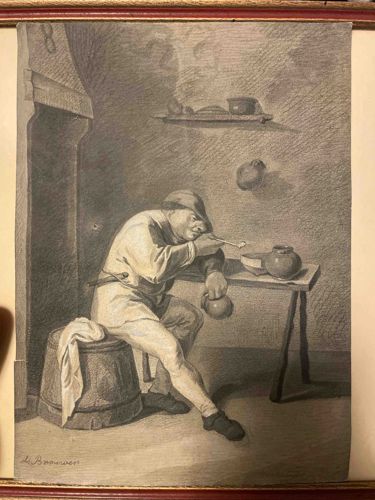
This is a framed monochrome drawing or print, possibly a graphite or chalk drawing, depicting a solitary man in an interior setting. The composition focuses on a male figure seated on a wooden barrel, with a cloth draped over it. He wears simple attire, including a tunic or shirt and trousers, and a cap. His posture suggests relaxation or perhaps slight inebriation, as he leans on a rudimentary wooden table, holding a small pipe to his mouth while also clutching a jug or tankard in his other hand. On the table, there's another larger jug and what appears to be a small dish. The background depicts a humble interior with a wall and a niche or fireplace on the left. Above the table, a shelf holds a few domestic items, and circular objects, possibly gourds or decorative elements, hang from the wall. The artwork is characterized by its dramatic use of light and shadow, creating depth and a somewhat somber mood. The technique shows fine lines and shading, indicating a skilled hand. A signature, 'L Brouwer', is visible in the lower left corner, suggesting it could be by or attributed to Adriaen Brouwer or a follower, known for genre scenes of peasant life. The item is housed in a simple rectangular frame, possibly wood with a reddish-brown finish, and is protected under glass. The visible condition appears good for its presumed age, with no obvious major damage, tears, or significant discoloration. The artwork captures a moment of everyday life, characteristic of Dutch Golden Age genre painting.
AI Appraisal Report
Based on my visual examination of the provided image of “A Man Smoking and Drinking in an Interior,” I assess this framed monochrome drawing or print. The condition appears to be good for its presumed age, with no visible tears, significant discoloration, or major damage, protected by glass within a simple reddish-brown wooden frame. The dramatic use of chiaroscuro and fine line work suggests a skilled hand.
The visible signature 'L Brouwer' is a critical factor. If this artwork is indeed by or authentically attributed to Adriaen Brouwer or his immediate workshop, the value would be significantly higher. However, based on an image alone, full authenticity verification is impossible. Many works of this period are by followers or in the style of prominent artists. Without in-person examination, provenance documentation (history of ownership), and potentially scientific analysis of the medium and support (e.g., paper analysis, ink composition), a definitive attribution cannot be made.
Considering it as a well-executed work in the style of Adriaen Brouwer, possibly a 17th or 18th-century copy or an original by a lesser-known contemporary, market comparables for similar high-quality Dutch/Flemish genre drawings or prints of that era by unauthenticated or lesser-known artists would typically fall into the $600-$1,500 range. Demand for such historical genre scenes remains steady among collectors. Rarity is difficult to assess without authentication; an authentic Brouwer would be rare, a good contemporary copy less so. The primary factor impacting value is the uncertainty of attribution. Should it be authenticated as an original Adriaen Brouwer, the value would increase dramatically into the tens of thousands, or even higher, depending on the specific medium. Therefore, the current appraisal reflects its aesthetic merit and historical style, acknowledging the significant limitation in verifying authenticity from an image.