AI estimate as of July 20, 2025 · verify with a professional before acting
AI-Generated · Verify before acting
Everything on this page is generated by AI for informational purposes only. AI can make mistakes — the AI may misidentify items or misattribute them (artist, maker, brand, designer, origin, era). This is not an official valuation and should not be used for insurance, sale, tax, estate, legal, or lending purposes — or any decision requiring a certified appraisal. It is not an authoritative claim about any person, brand, or rights holder — do not share or rely on it as a factual statement about a third party. Always consult qualified professionals before making financial decisions.
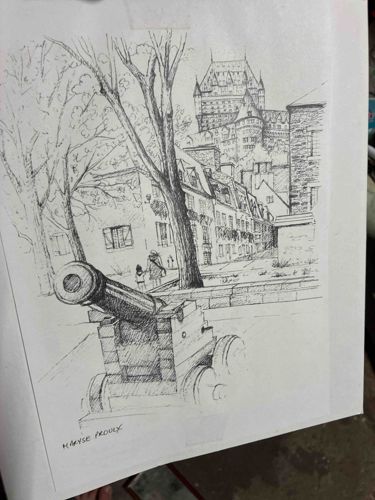
This is a monochrome ink drawing or print, likely a lithograph or etching, depicting a street scene with a prominent cannon in the foreground and a grand building, identifiable as the Fairmont Le Château Frontenac in Quebec City, in the background. The artwork primarily uses black ink on white paper, showcasing a detailed linework style with various hatching and cross-hatching techniques to create depth, shadow, and texture. The physical characteristics indicate a standard paper size, possibly 8.5 x 11 inches or close to it, given the visible borders. The composition is focused, drawing the viewer's eye from the cannon, through the street flanked by multi-story buildings with mansard roofs, reminiscent of European architecture, up to the iconic hotel structure. Notable features include the intricate rendering of the cannon's iron barrel and wooden carriage, the bare trees suggesting a late fall or winter setting, and the architectural nuances of the buildings, including windows, balconies, and rooftops. Two small figures appear to be walking in the mid-ground, adding a sense of scale and life to the scene. The condition appears good, with crisp lines and no significant visible damage, tears, or discoloration on the paper. There are no obvious signs of wear or repairs. A signature "H. HAYSE PROULX" is clearly visible in the lower left corner, indicating the artist. This suggests it is either an original drawing or a limited-edition print signed by the artist. Based on the architectural style and transportation, the artwork likely dates to the 20th or 21st century. The craftsmanship is high, demonstrating a skilled hand in perspective, architectural drawing, and the use of ink techniques. The quality can be assessed by the precision of the lines and the overall balance of the composition. The tape visible at the top edge of the image suggests it may have been temporarily affixed for display or storage, which is a minor external factor.
AI Appraisal Report
Based on my visual examination, the H. Hayse Proulx Quebec City print appears to be in very good condition. The linework is crisp, and there are no visible tears, significant discoloration, or creases. The presence of a clear signature in the lower left corner strongly suggests authenticity as either an original drawing or a hand-signed limited edition print. However, it's crucial to state that full authentication cannot be definitively confirmed from images alone. A physical inspection would be necessary to verify the paper type, ink quality, print method (e.g., lithograph, etching), and to check for hidden damages or repairs. Provenance documentation, such as a certificate of authenticity or purchase receipts, would also significantly aid in confirming its history and authenticity. Scientific testing, like microscopic analysis of the ink and paper, could further verify its age and originality.
Regarding market conditions, Quebec City landscapes, especially those featuring iconic landmarks like the Fairmont Le Château Frontenac, generally have consistent demand. While H. Hayse Proulx may not be a widely known artist in the broader fine art market, regional artists depicting popular local scenes can command a dedicated collector base. The apparent quality of the draughtsmanship and the intricate detail enhance its appeal. Factors impacting value include the actual print run size (if it’s a print), the specific medium (original drawing would be more valuable), and the artist's overall market presence. Given the lack of extensive public auction records, rarity is hard to assess without more information on the artist's output. Comparables for skilled regional artists' prints of similar subject matter typically range from low to mid-hundreds. The visible tape suggests it was handled, but its impact on value is minimal if the artwork itself is unaffected.
Limitations: Without physical inspection, I cannot confirm if it's an original drawing or a print, which significantly impacts value. Verification of edition size (if a print) is also impossible remotely. Therefore, this appraisal is based on the assumption that it is a well-preserved, signed work by the artist, likely a print.