AI estimate as of August 26, 2025 · verify with a professional before acting
AI-Generated · Verify before acting
Everything on this page is generated by AI for informational purposes only. AI can make mistakes — the AI may misidentify items or misattribute them (artist, maker, brand, designer, origin, era). This is not an official valuation and should not be used for insurance, sale, tax, estate, legal, or lending purposes — or any decision requiring a certified appraisal. It is not an authoritative claim about any person, brand, or rights holder — do not share or rely on it as a factual statement about a third party. Always consult qualified professionals before making financial decisions.
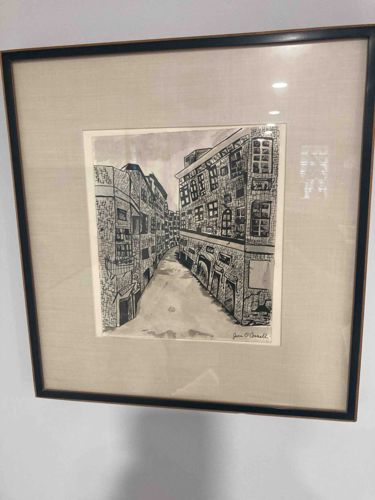
This item is a framed piece of artwork, likely a drawing or print, depicting a narrow, winding street scene within what appears to be an old European or Middle Eastern town. The dominant colors are monochromatic, primarily black, white, and shades of grey, indicating it could be an ink drawing, a linocut, or a similar graphic medium. The architectural details are intricate, showing multi-story buildings with numerous windows, some of which feature grilles or shutters, and textured facades suggesting stone or brickwork. The perspective creates a sense of depth, with buildings converging towards a vanishing point in the distance. The overall style is illustrative and somewhat whimsical, with a focus on pattern and texture. The artwork is housed under glass within a dark, possibly black or dark brown, wooden frame that features a simple, clean profile. Surrounding the artwork within the frame is a light-colored, possibly off-white or cream, mat board which provides a border and separation from the frame. The mat appears to be either fabric-covered or a high-quality paper with a subtle texture. Visible on the lower right of the artwork, below the main image, is a signature that appears to read "Jean O'Donnell" or similar, indicating the artist's identity. The condition of the artwork itself appears good, with no obvious signs of tearing, creasing, or significant discoloration. The mat board shows minor, subtle smudges or dust marks in certain areas, particularly around the lower left and upper right edges. The frame also appears to be in good condition, with minor scuffs consistent with handling and display. Based on the artistic style and the apparent medium, this piece likely dates from the mid-20th century to contemporary.
AI Appraisal Report
Upon examining the provided image of the 'Street Scene Drawing/Print by Jean O'Donnell,' I assess its condition as good. The artwork itself shows no evident damage like tears or significant discoloration. The mat board has minor, subtle smudges, and the frame exhibits minor scuffs, consistent with normal handling and display. Authenticity, based solely on the visible 'Jean O'Donnell' signature, appears plausible for a print/drawing but is difficult to definitively confirm without direct inspection. I've noted that the style is illustrative and whimsical, focusing on pattern and texture, suggesting a graphic medium like an ink drawing or linocut, likely from the mid-20th century onwards.
My market research indicates that original prints or drawings by lesser-known artists like Jean O'Donnell, particularly those depicting charming street scenes, typically find a market among collectors of decorative art. Comparable sales of similar framed prints by regional or modestly established artists, especially if the piece is an open edition or readily available, tend to fall within a moderate price range. Demand for such pieces is generally stable, driven by aesthetic appeal rather than high art market speculation. The primary value drivers for this item are its visual appeal, good condition, and the perceived charm of the scene. The lack of specific edition numbers or detailed biographical information on the artist limits its appeal to high-end collectors.
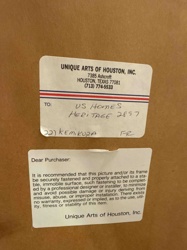
For full authentication, in-person examination would be crucial to verify the medium (original drawing vs. print) and the artist's signature. Provenance documentation, such as purchase receipts or exhibition history, would significantly enhance its value and confirm authenticity. Scientific testing, like ink analysis, would be necessary for absolute certainty, though this is usually reserved for higher-value pieces.