AI estimate as of October 23, 2025 · verify with a professional before acting
AI-Generated · Verify before acting
Everything on this page is generated by AI for informational purposes only. AI can make mistakes — the AI may misidentify items or misattribute them (artist, maker, brand, designer, origin, era). This is not an official valuation and should not be used for insurance, sale, tax, estate, legal, or lending purposes — or any decision requiring a certified appraisal. It is not an authoritative claim about any person, brand, or rights holder — do not share or rely on it as a factual statement about a third party. Always consult qualified professionals before making financial decisions.
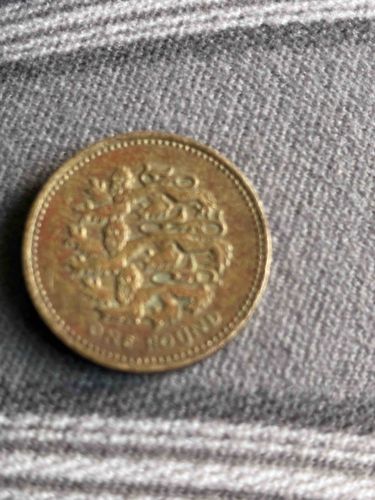
The item is a circular, brass-colored coin, consistent with the appearance of a British One Pound (£1) coin. The obverse side (as shown) features a detailed rendition of the Royal Coat of Arms of the United Kingdom, specifically the version used by King George IV, with a lion and a unicorn rampant supporting a shield, crowned with a royal crown. Below the shield, a ribbon or scroll is visible with the inscription "ONE POUND". The design is enclosed within a dotted or beaded border along the rim of the coin. The coin exhibits significant wear and tear, indicated by the dull, somewhat oxidized brass color and the softening of the relief details on the Coat of Arms. There are visible scratches and minor indentations across the surface, particularly noticeable on the flatter areas of the design. The overall patina is uneven, with darker areas suggesting deeper oxidation or accumulated dirt, and lighter, shinier spots where the metal has been rubbed more frequently. No specific mint marks or dates are clearly discernible from this image due to the wear and image resolution, though the general style suggests a coin from the late 20th to early 21st century. The craftsmanship is typical of mass-produced circulation coinage, with defined but not exceptionally sharp details, which have further diminished with circulation.
AI Appraisal Report
I have examined the provided image of what appears to be a British One Pound (£1) coin. Visually, the coin's brass-like color and the presence of the Royal Coat of Arms, specifically the George IV variant with the 'ONE POUND' inscription, are consistent with a genuine circulating British £1 coin. However, the coin exhibits significant wear and tear, including dullness, oxidation, softening of relief details, and numerous scratches and indentations. This level of circulation is typical for a coin that has spent considerable time in active use. The uneven patina further confirms its heavily circulated state.
Market conditions for common circulating British £1 coins are generally low. These coins represent face value currency, and unless they are a rare mint error, an uncirculated specimen, or a specific commemorative issue in pristine condition, their numismatic value rarely exceeds their monetary value. This particular coin's condition places it firmly in the 'spent' category, which severely limits any collector interest.
Demand for such a heavily worn coin is negligible. Rarity is not a factor here; millions of these coins were produced for general circulation. The significant wear is the primary factor impacting its value, reducing it to essentially face value, or slightly above for novelty as a foreign coin.
It is crucial to note that my assessment of authenticity is based solely on visual examination of the image. Without a physical inspection, I cannot verify the coin's metallic composition, precise weight, or detect any subtle indicators of counterfeiting that would be apparent to the touch or through closer scrutiny. To fully authenticate this coin, a hands-on examination, including weight and diameter measurements, and potentially spectroscopic analysis, would be required. However, given its condition, such extensive testing would likely be disproportionate to its potential numismatic value.