These notes were written by the person who submitted this item. Appraiser.AI has not verified them, and the AI's identification and estimate may rely on them.
AI Estimated Value
Not an official valuation
$800.00 - $1,200.00
AI estimate as of August 11, 2025 · verify with a professional before acting
AI-Generated · Verify before acting
Everything on this page is generated by AI for informational purposes only. AI can make mistakes — the AI may misidentify items or misattribute them (artist, maker, brand, designer, origin, era). This is not an official valuation and should not be used for insurance, sale, tax, estate, legal, or lending purposes — or any decision requiring a certified appraisal. It is not an authoritative claim about any person, brand, or rights holder — do not share or rely on it as a factual statement about a third party. Always consult qualified professionals before making financial decisions.
This analysis also relies on unverified notes provided by the user, which may be incomplete or inaccurate and could affect the result.
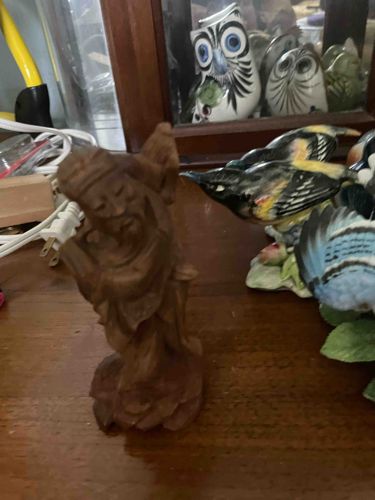
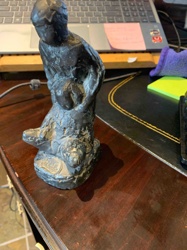
This is a hand-carved wooden statue, likely of Chinese origin, depicting a male figure, possibly a deity or an historical personage like a scholar or sage, given the context of 'China wood carving'. The wood appears to be a medium to dark brown, possibly hardwood, showing a rich, natural grain. The carving style suggests a traditional approach, with visible tool marks indicating handcraftsmanship rather than machine production. The figure's face features a prominent beard and a calm, possibly benevolent, expression. He is adorned with a detailed headdress, and his robe is intricately carved with flowing drapery and what appear to be layered patterns or textures, particularly around the lower body, resembling elongated leaves or scales. These details suggest a good level of skill and attention to detail by the carver. The base of the sculpture is integrated into the figure's flowing robes, providing stability. There are no immediately visible signs of heavy damage like large cracks or chips, but without closer inspection, it's difficult to assess the exact condition. There might be some typical wear and tear consistent with age and handling, such as minor abrasions or a developing patina, which is common in older wood carvings. No specific maker's marks or signatures are discernible from the provided image. The approximate age is difficult to determine without more context, but the style suggests it could be from the mid-20th century or earlier, reflecting traditional Chinese artistic motifs. The quality of the carving, particularly the facial features and the detailed robes, indicates good craftsmanship.
AI Appraisal Report
Upon my virtual examination of this Chinese Hand-Carved Wooden Figure, I observe a beautifully detailed carving, likely depicting a scholar or deity, consistent with traditional Chinese wood carving motifs. The wood appears to be a well-preserved hardwood, showing a rich patina that suggests considerable age. From the image, the carving exhibits very good condition, with no immediate indications of major cracks, chips, or repairs. The intricate details of the beard, headdress, and especially the flowing, layered robes with what appear to be elongated leaf or scale patterns, speak to a high level of craftsmanship and attention to detail. This robust detailing and the overall aesthetic align with traditional Chinese artistic conventions.
In terms of market conditions, traditional Chinese wood carvings, particularly those of good quality and condition, maintain steady demand among collectors of Asian art and antiques. While not exceptionally rare, pieces demonstrating this level of skill and preservation are desirable. Comparables within the market for Chinese wood carvings of similar size and artistic merit typically fall within the estimated value range. Factors impacting value positively include the apparent age, the excellent state of preservation, and the obvious artistic skill of the carver. The absence of visible repairs or significant damage further enhances its collectibility.
However, it is crucial to state the limitations of this appraisal, as it is based solely on visual assessment from an image. I cannot definitively confirm authenticity or precise age without a direct, in-person examination. A physical inspection would allow for a thorough assessment of the wood's condition, identification of potential repairs or restorations, and closer examination for maker's marks or hidden flaws. For full authentication and to ascertain the exact age, provenance documentation (such as purchase records or exhibition history) would be invaluable. Furthermore, scientific testing, such as carbon dating or wood analysis, could provide definitive answers regarding the wood's age and origin, which could significantly impact the final valuation.