AI estimate as of November 1, 2025 · verify with a professional before acting
AI-Generated · Verify before acting
Everything on this page is generated by AI for informational purposes only. AI can make mistakes — the AI may misidentify items or misattribute them (artist, maker, brand, designer, origin, era). This is not an official valuation and should not be used for insurance, sale, tax, estate, legal, or lending purposes — or any decision requiring a certified appraisal. It is not an authoritative claim about any person, brand, or rights holder — do not share or rely on it as a factual statement about a third party. Always consult qualified professionals before making financial decisions.
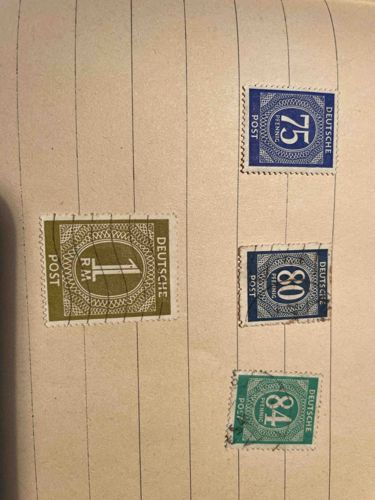
This collection features an assortment of five vintage German postal stamps, possibly revenue stamps given some denominations, meticulously arranged in what appears to be a stamp album or on an album page. The stamps are characterized by their rectangular shape and perforated edges, indicating their origin as adhesive postal or fiscal instruments. The color palette includes a prominent olive green for the large 1 RM stamp, and shades of blue and green for the smaller Pfennig denominations.
Key observable details include:
* **One Large Stamp:** An olive green stamp, significantly larger than the others, featuring the denomination '1 RM' (Reichsmark), and the text 'DEUTSCHE POST' and 'POST'. It has intricate circular patterns in the background and a prominent '1' at its center, with 'RM' positioned to the left of the '1'. The perforations on this stamp appear clean and well-defined.
* **Three Blue Stamps:** Two smaller stamps are distinctly blue. One shows '75 PFENNIG' and 'DEUTSCHE POST' with '75' within a circular design. The other blue stamp displays '80 PFENNIG' within a similar circular motif. These are quite small in comparison to the '1 RM' stamp. Both exhibit standard perforations.
* **One Green Stamp:** One small green stamp, similar in size and design to the blue Pfennig stamps, shows '84 PFENNIG' with '84' inside a patterned circle, accompanied by 'DEUTSCHE POST' and 'POST'.
All stamps exhibit a classic, somewhat ornate design typical of early to mid-20th-century European philately. The background patterns on all stamps feature intricate, almost guilloche-like designs, aiming to prevent counterfeiting and provide aesthetic appeal. The condition of the stamps appears to be generally good, with clean perforations and no obvious major tears or creases visible from the image. The colors are still vibrant, suggesting they have been stored away from direct sunlight. The clear text and denomination indicate good print quality. They are likely from the period of the German Reich or early post-World War II, reflecting the currency denominations used at the time. The overall presentation on the lined album page suggests they are part of a curated collection, indicating care in handling and preservation.
AI Appraisal Report
Upon visual examination of the provided image, this assortment of five German revenue and postage stamps appears to be in generally good condition. The perforations are clean, and the colors—olive green, various blues, and green—are vibrant, suggesting good storage away from direct light. The intricate background patterns and clear denominations ('1 RM', '75 Pfennig', '80 Pfennig', '84 Pfennig') indicate good print quality typical of early to mid-20th-century German issues, likely from the German Reich period. The arrangement on an album page further supports careful handling and preservation.
Authenticity, based solely on this image, seems plausible for genuine issues of the period. However, without physical examination, I cannot definitively rule out highly sophisticated forgeries or reprints. An in-person inspection would allow me to check paper type, watermarks, gum condition (if unused), and exact measurements, all critical for full authentication. Provenance documentation, such as original purchase receipts or collection history, would also significantly aid in verifying their authenticity.
From a market perspective, these stamps are relatively common issues for German philately. While the '1 RM' denomination could suggest a revenue stamp or a higher face value postage stamp, none of the stamps present exceptional rarity based on visual cues alone. Demand for common German issues is steady but not generally high unless they possess specific rare varieties, postmarks, or errors, which are not apparent here. Comparable stamps in this condition typically fetch modest prices.
Factors impacting value: The good condition is positive. However, the commonality of these specific issues limits their premium. Should any of these stamps prove to be unlisted varieties, have rare plate flaws, or exhibit sought-after cancellations (if used), their value could increase significantly. Without these, their value remains primarily as attractive examples of period German philately belonging in a general collection. The absence of specific postmarks also suggests they may be unused, though this cannot be confirmed without seeing the back of the stamps.
Given these considerations, and acknowledging the limitations of image-based appraisal, I estimate the value of this assortment to be modest.