AI Item Analysis
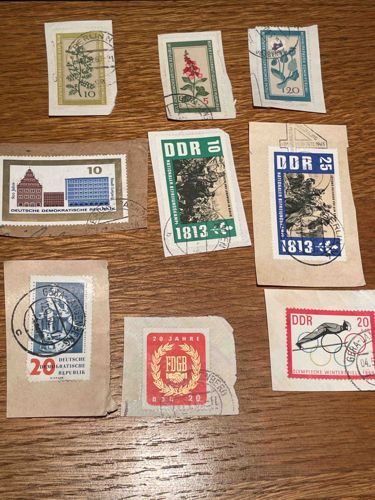
This is a collection of nine vintage postage stamps, presumed to be from the German Democratic Republic (DDR), based on the prominent 'DDR' markings on several of the stamps. The stamps are affixed to various pieces of paper, suggesting they have been removed from envelopes or parcels and possibly collected as 'on-paper' stamps.
Physical characteristics vary; the stamps themselves are small rectangular pieces of paper with serrated edges, typical of postage stamps. The individual paper pieces they are attached to vary in size and shape, being irregularly torn from their original sources. Colors are diverse, ranging from muted greens, browns, and blues to more vibrant reds and golds.
Notable features include various designs: some stamps depict botanical illustrations (flowers), others feature historical or architectural scenes (a building complex), and some commemorate events or organizations (one stamp reads '20 JAHRE FDGB' with a handshake emblem, another 'OLYMPISCHE WINTER'). The designs are indicative of post-war European aesthetic and printing techniques.
Condition issues are evident. All stamps show signs of having been used, as indicated by postmarks ('GERA', 'BERLIN'). The paper they are attached to exhibit creases, tears, and discoloration due to age and handling. Some stamps are torn or have missing perforations, particularly the ones at the top of the image. The attachment of the stamps to paper in a 'on-paper' state suggests they have not been meticulously separated for philatelic preservation.
Manufacturing details include prominent 'DDR' markings and values such as '5', '10', '20', and '25', indicating their face value in the currency of the time. The year '1813' is visible on stamps depicting what appears to be a battle scene, likely commemorating a historical event. The '20 JAHRE FDGB' stamp refers to 20 years of the Freier Deutscher Gewerkschaftsbund (Free German Trade Union Federation). The 'OLYMPISCHE WINTER' stamp hints at winter Olympic games.
Estimated age: Given the 'DDR' designation, these stamps date from between 1949 and 1990, the period of the German Democratic Republic's existence. The specific designs and commemorative dates (e.g., '20 JAHRE FDGB', '1813') would allow for more precise dating within this period. The overall style and condition suggest mid-to-late 20th century.
Quality indicators and craftsmanship details: The printing quality appears standard for government-issued postage stamps of the era, displaying clear imagery and text despite the small scale. The irregular tearing of the surrounding paper indicates a less formal or professional approach to removal and collection.