AI estimate as of November 9, 2025 · verify with a professional before acting
AI-Generated · Verify before acting
Everything on this page is generated by AI for informational purposes only. AI can make mistakes — the AI may misidentify items or misattribute them (artist, maker, brand, designer, origin, era). This is not an official valuation and should not be used for insurance, sale, tax, estate, legal, or lending purposes — or any decision requiring a certified appraisal. It is not an authoritative claim about any person, brand, or rights holder — do not share or rely on it as a factual statement about a third party. Always consult qualified professionals before making financial decisions.
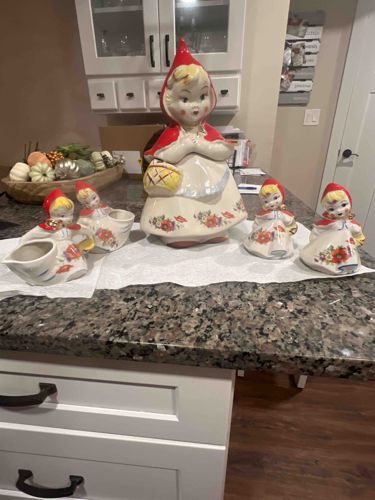
This is a delightful vintage ceramic kitchenware set, primarily featuring characters reminiscent of Little Red Riding Hood. The centerpiece is a large cookie jar shaped like Little Red Riding Hood herself, depicted with a rosy-cheeked face, blonde hair peeking out from under a bright red hooded cape, and a white apron adorned with floral patterns. Her hands are clasped in front, holding a small yellow basket with cross-hatch details. The cookie jar appears to be made of glazed ceramic, predominantly in cream, red, and yellow, with hand-painted facial features and floral accents in shades of red, green, and brown. The glaze shows a glossy finish, and the overall condition appears to be good with no obvious chips or cracks visible from the provided images, though minor crazing or paint loss typical of vintage ceramics may be present upon closer inspection. Surrounding the large cookie jar are several smaller matching pieces, likely a creamer, sugar bowl, and possibly salt and pepper shakers or other decorative figures. These smaller pieces also feature figures dressed in red hoods and floral-patterned attire, mirroring the design of the main cookie jar. For instance, one piece appears to be a creamer with a spout, featuring a young figure sitting, while another is a sugar bowl with a matching lid. The figures have a distinct mid-century design aesthetic, characterized by their stylized, almost childlike features and vibrant colors. The craftsmanship suggests molded ceramic, likely mass-produced but with hand-finished painted details. These sets were popular in the mid-20th century, particularly from the 1940s to 1960s. The entire set exudes a charming, nostalgic appeal, making it a collectible item for enthusiasts of vintage kitchenalia and fairy tale-themed decor.
AI Appraisal Report
Based on my visual examination of the provided images, this Vintage Little Red Riding Hood Ceramic Kitchenware Set appears to be in very good vintage condition. The main cookie jar, the centerpiece, shows no obvious chips or cracks, and the glaze retains its glossy finish. The hand-painted details, while consistent with mid-century production, seem well-preserved. Similarly, the accompanying smaller pieces—a creamer, sugar bowl, and other decorative figures—also appear intact and consistent in style and condition. However, without a physical inspection, I cannot rule out minor crazing, subtle hairline cracks, or paint loss that would be typical for ceramic pieces of this age (likely 1940s-1960s). Authenticity, given the commonality of these sets, is generally confirmed by consistent design elements, period manufacturing marks (if present, which are not visible here), and overall quality.
The market for vintage fairy-tale themed kitchenware, particularly Little Red Riding Hood sets, remains strong among collectors of mid-century Americana and kitchenalia. Comparables for complete sets in excellent condition often fetch a premium. Factors impacting value significantly include the completeness of the set, the absence of damage (chips, cracks, significant paint loss), and the presence of original manufacturing marks. While demand is steady, these sets are not exceptionally rare, but finding a complete set in this apparent condition is less common. For full authentication and a more precise condition assessment, a thorough in-person examination would be required to check for crazing, hidden damage, and to verify any maker's marks not visible in the images. Provenance documentation, though rarely available for these items, would also add value.