AI Appraisal Estimate

AI-generated estimates · not official valuations

From the user

What was submitted

Photo and notes provided by the user — not generated by AI

Submitted item photo
Submitted photo · June 13, 2026

User's notes

No additional notes provided.

AI analysis below

AI appraisal

AI analysis & estimate

AI-Generated · Verify before acting

Everything below is generated by AI for informational purposes only. AI can make mistakes — the AI may misidentify items or misattribute them (artist, maker, brand, designer, origin, era). This is not an official valuation and should not be used for insurance, sale, tax, estate, legal, or lending purposes — or any decision requiring a certified appraisal. It is not an authoritative claim about any person, brand, or rights holder — do not share or rely on it as a factual statement about a third party. Always consult qualified professionals before making financial decisions.

Read the full disclaimer

AI Identification

·Not independently authenticated·Verify before acting

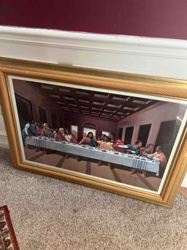
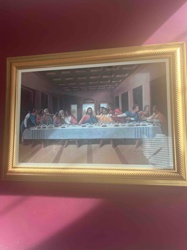
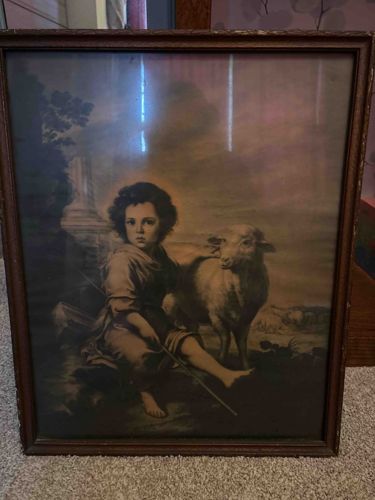
Framed Print of 'The Good Shepherd' by Bartolomé Esteban Murillo

Wall Decor / Religious Art Prints

AI Estimated Value

·Not an official valuation·Verify before acting

$45 - $85

As of June 13, 2026

AI Item Analysis

·AI can make mistakes·Verify before acting
This is a vintage framed lithographic print or high-quality photogravure reproduction of 'The Good Shepherd' (circa 1660), a famous masterpiece by the Spanish Baroque painter Bartolomé Esteban Murillo. The image depicts a young, idealized Christ Child as a shepherd, seated in a pastoral landscape with a sheep by his side. The artwork features a soft, sfumato technique characteristic of Murillo's style, with muted earth tones, soft ochres, and hazy atmospheric light in the background. The central figure has dark curly hair, an expressive face, and is dressed in modest robes, holding a shepherd’s staff. The composition is set against a backdrop of classical ruins and a soft, cloudy sky. The piece is housed in a simple, dark wood frame with a slightly distressed finish and a thin inner gold-tone or gilded lip. The frame shows visible signs of age and wear, including scuffing, minor wood loss, and chipping along the top and side edges. The glass cover shows significant light reflections and glare in the photograph, but the print itself appears to have some tonal fading consistent with mid-20th-century reproductions. There are no visible maker's marks or signatures on the surface of the print in this view. The size appears to be a standard large-format wall art size, likely dating from the early to mid-20th century, a period when such religious reproductions were popular for home decor. The overall craftsmanship of the frame is basic, suggesting a mass-produced decorative item rather than a custom artisan framing.
AI Appraisal Report

·AI can make mistakes·Verify before acting
I have conducted a visual examination of this framed reproduction of Bartolomé Esteban Murillo’s 'The Good Shepherd.' The item is a mid-20th-century lithographic print, not an original oil painting or a limited edition hand-pulled engraving. The muted color palette and soft focus are indicative of mechanical reproduction techniques common in the 1940s through 1960s. The frame is a mass-produced dark wood moulding with a gilded fillet, showing significant wear, including chipping and scuffing, which detracts from the decorative value. The print displays noticeable tonal fading, likely due to UV exposure over several decades. In the current market, religious lithographs of this era are highly common and lack rarity. They were produced in large quantities for the domestic market. Comparison with similar sold items at estate auctions and secondary marketplaces shows that these pieces typically realize modest prices, primarily as decorative or sentimental objects rather than investment-grade art. The condition of the frame significantly impacts the value, as the cost of professional Reframing would likely exceed the total market value of the piece. Limitations: This appraisal is based solely on digital images. Without a physical inspection, I cannot confirm the exact printing process (e.g., offset lithography vs. photogravure) or the condition of the paper substrate behind the glass. A full authentication would require removing the backing to inspect for publisher marks, watermarks, or hidden foxing. While this is clearly a reproduction, any claim of higher value would necessitate provenance documentation or a forensic analysis of the ink and paper fibers to determine a more precise manufacturing date.

Get your items appraised

Instant estimates of your treasures with AI-powered appraisals

Browse More Appraisals