AI Appraisal Estimate

AI-generated estimates · not official valuations

From the user

What was submitted

Photo and notes provided by the user — not generated by AI

Submitted item photo
Submitted photo · May 27, 2026

User's notes

No additional notes provided.

AI analysis below

AI appraisal

AI analysis & estimate

AI-Generated · Verify before acting

Everything below is generated by AI for informational purposes only. AI can make mistakes — the AI may misidentify items or misattribute them (artist, maker, brand, designer, origin, era). This is not an official valuation and should not be used for insurance, sale, tax, estate, legal, or lending purposes — or any decision requiring a certified appraisal. It is not an authoritative claim about any person, brand, or rights holder — do not share or rely on it as a factual statement about a third party. Always consult qualified professionals before making financial decisions.

Read the full disclaimer

AI Identification

·Not independently authenticated·Verify before acting

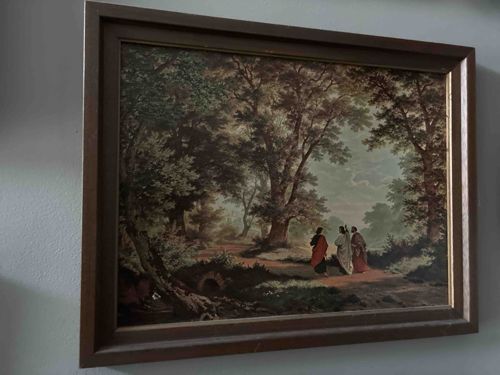
The Road to Emmaus Wood Framed Print

Wall Art & Religious Decor

AI Estimated Value

·Not an official valuation·Verify before acting

$45-85

As of May 27, 2026

AI Item Analysis

·AI can make mistakes·Verify before acting
This item is a landscape art print depicting the biblical scene of the 'Road to Emmaus' (Likely after an 18th or 19th-century European master, such as Henri Pluchart or an anonymous artist of that era). The scene features three figures dressed in classical robes walking along a dirt path flanked by dense, lush deciduous trees. The color palette is dominated by earthy greens, deep browns, and muted ochres, with the figures providing small focal points of red and white. The artwork is characterized by high-contrast lighting, typical of Baroque or Romantic-era landscape styles, where light filters through a dense forest canopy. The print appears to be on a paper or fine cardstock substrate, matted directly into a simple, dark-stained wooden frame. The frame features a flat, stepped profile with visible wood grain and a inner gold-toned fillet or bevel that draws the eye toward the artwork. In terms of condition, there are visible scuffs and scratches on the lower edge of the wooden frame, along with a small chip on the top edge. The print itself shows some minor undulation and potential fading consistent with light exposure and mid-to-late 20th-century age. No visible artist signature or maker's marks are present in the photograph, suggesting it is a commercial lithographic reproduction rather than an original painting. The overall level of craftsmanship in the framing is standard for decorative home furnishings from the 1960s-1980s.
AI Appraisal Report

·AI can make mistakes·Verify before acting
Based on my visual examination of the provided imagery, I find this work to be a high-quality vintage lithographic reproduction of the biblical 'Road to Emmaus' scene. The style of the frame and the mounting techniques suggest a mid-to-late 20th-century production date, likely between 1960 and 1985. The print is housed in a mass-produced dark-stained wood frame with a gold-tone fillet. While the composition reflects the gravitas of 19th-century European masters, the absence of a visible signature or limited edition numbering confirms this is a commercial decorative piece rather than a fine art original or a hand-pulled print. The condition is fair to good; I note visible abrasions and chipping on the frame edges and minor undulation of the paper substrate, likely caused by humidity or lack of acid-free backing. Market demand for religious decor of this period remains steady but is generally limited to the secondary decorative market rather than high-end art auctions. Similar items frequently appear in estate sales and regional auctions with realized prices typically under $100. The primary value lies in its devotional aesthetic and functional framing. Crucially, as this appraisal is based on digital images, I cannot verify the specific printing method (such as offset lithography vs. more modern digital processes) or the acidity of the paper. A physical inspection would be required to rule out any potential for a hand-painted surface or to identify specific plate marks. For full authentication, provenance documentation or a physical review of the reverse side (backing) would be necessary to identify the publisher or manufacturer.

Get your items appraised

Instant estimates of your treasures with AI-powered appraisals

Browse More Appraisals